

When Albert Einstein and Nathan Rosen first imagined “bridges” connecting distant parts of spacetime, they likely never envisioned them wriggling with quantum complexity.
Yet according to a new theoretical study, that’s precisely what the universe’s most common black holes may contain—vast, tangled networks of semiclassical wormholes dubbed “Einstein-Rosen caterpillars.”
In research published in Physical Review Letters, physicists Dr. Javier M. Magán of Instituto Balseiro, Dr. Martin Sasieta, and Dr. Brian Swingle of Brandeis University introduce a groundbreaking model showing that the interiors of typical black holes aren’t smooth, symmetrical tunnels, but sprawling, chaotic labyrinths of quantum entanglement.
Their findings expand on the bold idea that wormholes—theoretical tunnels through space-time—might actually be physical manifestations of quantum entanglement, the mysterious link that allows particles to instantly affect each other across vast distances.
“The states contain very long Einstein-Rosen caterpillars: semiclassical wormholes with large numbers of matter inhomogeneities,” the researchers write. “Distinguishing these ensembles from the typical entangled states of the black holes is hard.”
Proposed a decade ago by physicists Dr. Juan Maldacena and Dr. Leonard Susskind, the ER = EPR idea—linking Einstein-Rosen bridges (wormholes) with Einstein-Podolsky-Rosen quantum entanglement—makes a bold claim: that the fabric of spacetime and the invisible connections between entangled particles are actually two expressions of the same underlying reality.
In simple terms, whenever two particles—or even two black holes—become quantumly entangled, they might be linked by a tiny, hidden wormhole known as an Einstein-Rosen bridge.
Nothing can travel through this bridge, but it offers a striking visual way to think about how information and geometry might be connected at the deepest levels of reality.
Traditionally, this bridge is modeled by a finely tuned “thermofield double” (TFD) state—a mathematical construct representing two identical black holes in perfect thermal equilibrium.
However, the TFD is, as the authors put it, “rather atypical.” Real black holes are messy, constantly perturbed by the chaotic motion of particles and radiation around them.
The new study asks a deeper question: What does a typical entangled state between two black holes really look like?
Researchers’ answer paints a far stranger picture. Using advanced mathematical ensembles and random quantum circuits, the team modeled how black holes evolve when driven not by smooth, predictable forces, but by noisy, random dynamics more reflective of nature itself.
As these systems evolve, their interiors don’t remain neat wormhole tunnels—they grow into long, uneven, and bumpy geometries. Researchers dubbed these mathematical structures “Einstein-Rosen caterpillars.”
Unlike the simple, symmetrical wormholes often visualized in science fiction, Einstein-Rosen caterpillars are deeply irregular. They consist of fluctuating regions of spacetime stitched together by dense webs of quantum entanglement. Each bump or distortion corresponds to local inhomogeneities—tiny variations in the quantum fields that make up the interior geometry.
In the researchers’ model, these wormholes emerge naturally from ensembles of entangled black hole states. The longer a black hole system evolves under random dynamics, the longer and more complex the wormhole becomes.
At sufficiently late times, these wormholes statistically resemble what the authors call “typical equilibrium entangled states”—the most probable configurations of two black holes in the universe.
Crucially, the paper quantifies this relationship. The team derived what they term a “length–randomness correspondence,” showing that the geometric length of a wormhole increases with the degree of quantum randomness—or complexity—of the underlying state. This formalizes a long-suspected principle in quantum gravity that complexity equals geometry.
“We quantify this by deriving the correspondence between a microscopic notion of quantum randomness and the geometric length of the wormhole,” researchers write. “This formalizes a ‘complexity = geometry’ relation.”
In simpler terms, the more scrambled the quantum information between two black holes becomes, the longer and more intricate the wormhole connecting them grows.
By constructing these so-called Einstein-Rosen caterpillar wormholes, researchers offer a tangible way to imagine what the inside of a typical black hole might look like. Rather than being smooth or perfectly ordered, its interior appears statistically random and dynamically complex—a chaotic geometry shaped by quantum entanglement itself.
These findings suggest that even within the apparent chaos of quantum systems, spacetime geometry remains a robust feature, continuously emerging from entanglement.
This challenges long-standing arguments that typical black hole interiors can’t be semiclassical—those that claim random quantum states lead to “firewalls” or violent breakdowns of spacetime near the event horizon. The authors argue instead that their models maintain smooth, extended interiors well beyond these limits.
“The ensembles of caterpillars constructed in this Letter provide a window into the generic structure of the black hole Hilbert space in any theory of gravity with low-energy matter,” the researchers write. “The construction and main result support a vastly more general form of ER = EPR and seem to be in some tension with arguments against semiclassicality of typical interiors.”
In other words, the study suggests that even the most random, high-uncertainty black holes may still possess coherent spacetime interiors. They may be complex and chaotic, but they aren’t destroyed.
The findings also touch on one of the most perplexing problems in modern physics: the black hole firewall paradox. At its core, it represents a deep clash between the rules of quantum mechanics and the predictions of general relativity.
Quantum theory suggests that information can never be truly lost, even if it falls into a black hole. However, Einstein’s theory of general relativity insists that crossing the event horizon should be uneventful, with no sudden burst of energy or destruction.
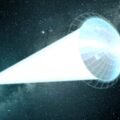
Reconciling these two ideas leads to a dilemma: if information is preserved, then the horizon might have to erupt into a blazing wall of radiation—a “firewall”—that incinerates anything trying to pass through.
However, the Einstein-Rosen caterpillar model suggests that the distinction between black holes with firewalls and those without may be so subtle that, in practice, it could be impossible to tell the difference.
These wormhole ensembles form what physicists call quantum state k-designs—collections of states that look statistically identical up to many levels of measurement. Because of this, the authors suggest that beyond a certain level of randomness, it may become fundamentally meaningless to ask whether a black hole has a firewall at all.
“Distinguishing states with firewalls from those without is extremely difficult,” researchers note. “In fact, if we could extrapolate our result to exponentially large values of k, the indistinguishability would be so strong that the very question of whether a state has a firewall might become meaningless.”
This perspective reframes the debate entirely. Rather than treating firewalls as physical boundaries, they might instead represent statistical limits on what can ever be known about a black hole’s interior.
In a tantalizing conclusion, the researchers hint that their abstract mathematics could someday inspire real-world experiments.
Recent advances in quantum simulation and “quantum gravity in the lab” have already demonstrated ways to emulate black hole physics using superconducting circuits and entangled qubits.
Researchers suggest that their wormhole constructions might eventually be implemented using postselection or quantum algorithms designed for imaginary-time evolution.
“It would be interesting to construct and study these states in the lab as a way of directly probing the black hole interior,” researchers propose.
If such experiments become possible, scientists could—for the first time—observe analogues of black hole interiors forming and evolving inside a quantum computer, inching closer to testing the very foundations of spacetime itself.
Ultimately, the concept of “Einstein-Rosen caterpillars” may sound slightly comical. However, the theory strengthens the view that geometry, gravity, and perhaps even the flow of time emerge from deeper layers of quantum information.
Each irregularity in these hypothetical wormholes reflects measurable patterns of quantum randomness, offering a new framework for exploring how the universe’s structure arises from its most fundamental connections.
Tim McMillan is a retired law enforcement executive, investigative reporter and co-founder of The Debrief. His writing typically focuses on defense, national security, the Intelligence Community and topics related to psychology. You can follow Tim on Twitter: @LtTimMcMillan. Tim can be reached by email: tim@thedebrief.org or through encrypted email: LtTimMcMillan@protonmail.com