

More than 140 million miles away from Earth, a rare event recently occurred in the twilight skies above Mars, and it was all captured on camera by NASA’s Perseverance rover.
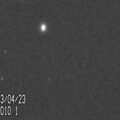
Imagery of a celestial alignment, featuring Earth as it briefly vanished behind the Martian moon Phobos, was revealed in composite photos captured by Perseverance’s Mastcam-Z instrument in early July as the intrepid rover embarked on its 1,907th Martian day, or sol, on the Red Planet.
The rover’s Mastcam-Z camera system, developed by Arizona State University in collaboration with Malin Space Science Systems, was built for capturing high-resolution panoramic zoom imagery of the Martian landscape. Although its main objectives involve its investigations of Jezero Crater and ancient geological features preserved there for eons, which may even include evidence of past microbial life, cases like the recent celestial alignment showcase how the rover’s cameras can also provide unique insights into astronomical events.

A Robot on Mars Captures an Occultation
Captured against fading twilight, our Earthly home appears as little more than a tiny, bright speck of light as it slowly passes behind the irregularly shaped Martian moon, in what astronomers refer to as an occultation.
NASA applied processing to the rare images, which helped to filter out some of the background light, revealing the brief celestial pairing in greater detail. The resulting imagery offers a glimpse of a dark backdrop that now better highlights the motion of Earth and Phobos in their treks through the Martian sky.
A Sunset Unlike Any Other
The image was obtained roughly 40 minutes after the Martian sunset, as the natural orbital path Phobos follows causes it to appear to drift upward in the new sequence of images, while Earth moves diagonally downward, then slips out of view behind the oddly shaped Martian companion.

In an annotated version released by NASA, timestamps spanning just 40 seconds illustrate the progression of the event in single frames, offering a look at a sunset unlike any ever seen on Earth.
That isn’t to say that the same effect can’t be seen from our planet, but in reverse: a lunar occultation where Mars passes behind the Moon can also be observed here, under the right conditions.
Occultations are frequently used by astronomers to help study the positions and motions of various celestial bodies in this way. However, seeing one from the surface of another planet is a rare treat, offering a view of Earth as a distant point of light.
In the past, Perseverance has also captured images of a lunar eclipse from its position on the Martian surface, as Phobos was seen passing in front of the Sun. Past imagery collected by NASA’s robotic explorer has also documented appearances of the Martian moon Deimos in the Red Planet’s early morning skies.
Colors of Change on a Red Planet
Although Mars’ characteristic rusty hues are ever-present, the recent imagery also offers a glimpse of other subtle colors seen in the Martian environment, particularly at twilight. With subtle bluish grays that gradually transition to redder tones, the new images offer a more nuanced and colorful look at the Red Planet.

Perseverance has now spent more than five years exploring Mars, and its ongoing discoveries have added a wealth of new information to the growing body of knowledge scientists have collected about our nearby planetary neighbor.
As for the recent imagery the rover captured, such a unique view requires careful timing, along with a bit of good fortune, according to Mark Lemmon, a Mastcam-Z co-investigator at the Space Science Institute in Boulder, Colorado.
“Phobos crosses the Martian sky three times a day, and Earth is visible for months at a stretch,” Lemmon said in a statement, adding that “catching one directly behind the other takes planning and a little luck.”
Additional details provided by NASA about the new imagery can be found here and here.
Micah Hanks is the Editor-in-Chief and Co-Founder of The Debrief. A longtime reporter on science, defense, and technology with a focus on space and astronomy, he can be reached at micah@thedebrief.org. Follow him on X @MicahHanks, and at micahhanks.com.