Could life in our universe have its origins with the explosions of the first massive stars, and the enrichment of their environments with heavy elements?
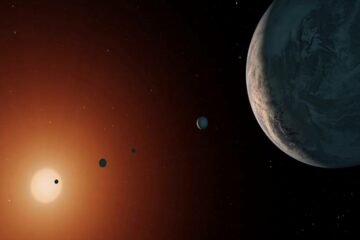
Avi Loeb looks at SpaceX's ambitions, the exploration of habitable exoplanets like TRAPPIST-1d, and the broader implications for human space travel and settlement.
The restricted three-body problem involves a stable orbit of two large bodies accompanied by a small third body. Here's how it also relates to human interactions.
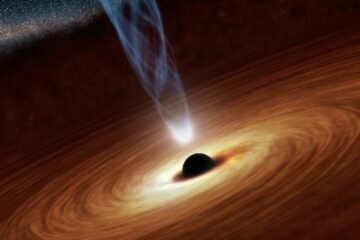
What are tidal disruption events? Try imagining the sun moving close to the speed of light and colliding with another sun as they move around a black hole.
Humans evolved from chimpanzees and reached the Moon by developing a language. But why is communication so advantageous for the evolution of a species?
Supermassive black holes and stars initially competed for gas in the early universe, influencing the likelihood of life and the cosmic balance of energy.
Harvard astronomer Avi Loeb considers the effects of rockets on the Earth, following the latest test launch of the massive SpaceX Starship from Boca Chica, Texas.
Neutrinos are electrically neutral particles that interact only through the weak interaction and gravity. If our eyes were sensitive to neutrinos, what would we see?
Astronomer Avi Loeb describes his "eureka moment" about the origin of IM1-like objects in interstellar space from planetary systems around dwarf stars.
Might an iron peanut be worth ten thousand spherules, or nothing at all? Avi Loeb and the Galileo Project team's expedition to the Pacific waters off Papua New Guinea draws to a close.
As the Galileo Project team's expedition winds down, Avi Loeb provides a series of updates on the search for spherules believed to be associated with an interstellar meteor.
Avi Loeb presents a new series of updates on the search for spherules believed to be associated with an interstellar meteor retrieved during the Galileo Project team's expedition.
Magnetic spherules are detected under the microscope by Avi Loeb and the Galileo Project team in this latest installment of 'Diary of an Interstellar Voyage.'
More materials are recovered, and new questions surface, in this combined three-part entry covering Day 8 (June 18, 2023) of the Galileo Project team’s expedition.
The Galileo Project continues its recovery of material from the ocean floor during its expedition to recover an interstellar object off the coast of Papua New Guinea.
Scooping the Ocean Floor: The Galileo Project team's magnetic sled is lowered to bottom of the Pacific in the fourth installment of "Diary of an Interstellar Journey."
Harvard Astronomer Avi Loeb and the Galileo Project team begins its efforts to retrieve an interstellar object at the bottom of the Pacific in this third installment of "Diary of an Interstellar Journey."
This second installment in a series documents Harvard Astronomer Avi Loeb and the Galileo Project's expedition to recover an interstellar object from the floor of the Pacific Ocean.
Harvard Astronomer Avi Loeb documents the Galileo Project's expedition to attempt the recovery of an interstellar object from the floor of the Pacific Ocean.
Suppose NASA astronauts had images of technological objects hovering above Earth that are not identified as human made. Should they share the data with the public or worry that such an act would generate turmoil in society?
On April 19, 2023, exactly 248 years after the Lexington-Concord Battle, a public Senate hearing on UAP is to be held by the Senate Committee on Armed Services.