

During the last Ice Age, modern humans had ongoing encounters with more than one variety of now-extinct Pleistocene-era hominin.
Those encounters, according to new research, not only resulted in interbreeding between homo sapiens and other types of archaic humans—they may have helped some of the earliest arrivals in North America survive.
According to new findings published in Science, genetic evidence of past interbreeding between early modern humans and our ancient cousins, the Neanderthals and Denisovans, suggests that these encounters may have played a significant role in helping humans adapt to new environments they encountered during early migrations into North America.
“Modern human genomes contain a small number of archaic variants, the legacy of past interbreeding events with Neanderthals and Denisovans,” the authors of the new study report.
“Most of these variants are putatively neutral,” they write, “but some archaic variants found in modern humans have been targets of positive natural selection and may have been pivotal for adapting to new environments as humans populated the world.”
Strangers in a New Land
The earliest arrival of anatomically modern humans in North America has been a subject of intense debate for several decades. Increasingly with time, discoveries by archaeologists have continued to push back the time scales on when those arrivals began, with initial estimates of early human dispersals into North America beginning as recently as around 13,000 years ago now having been expanded to well past 20,000 years ago.
Recent confirmation of human ichnofossil footprints at White Sands National Park, dating to between 21,000 and 23,000 years ago, offers compelling clues to an ever-expanding narrative of human migrations into North America.
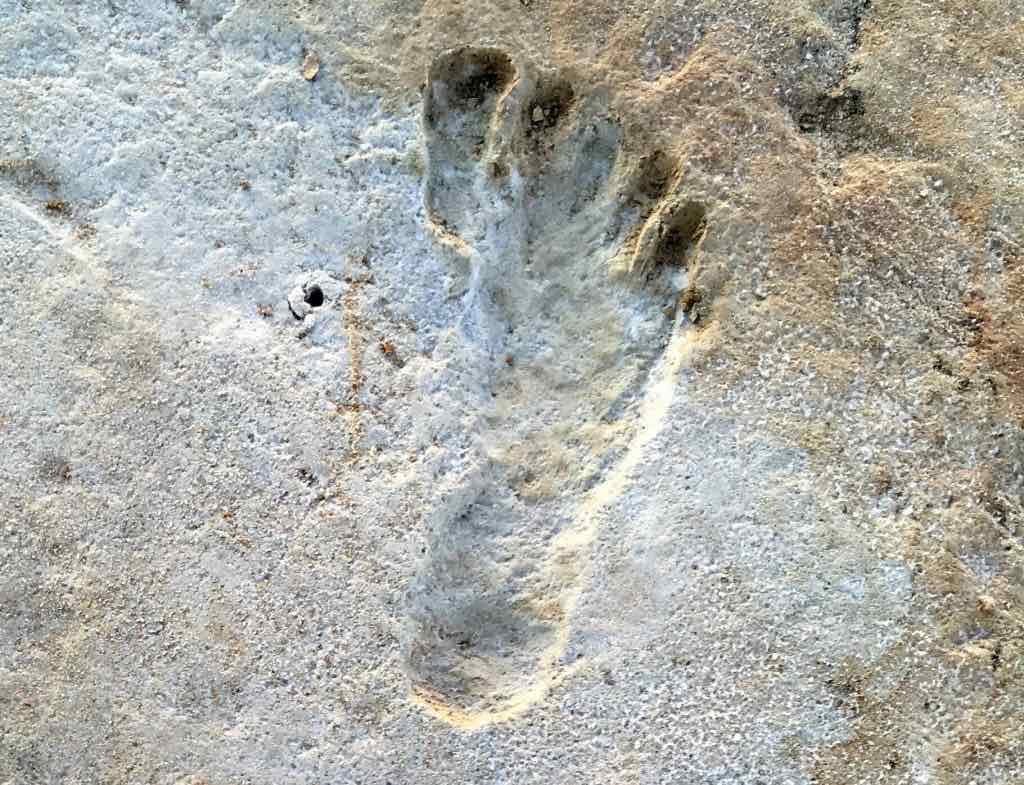
Naturally, if humans arrived much earlier than previously believed possible, this suggests that the harsh conditions of the last Ice Age may also have been prevalent at the time of these early migrations into America.
Natural Selection at Work
According to the new study’s authors, the new and often challenging environments early visitors to North America likely encountered meant that natural selection played a role in determining which qualities these ancient humans possessed were deemed best suited for survival.
“American populations encountered a myriad of novel environments,” the study’s authors write, “providing the opportunity for natural selection to favor archaic variants in these new environmental contexts.”
“All of a sudden, people had to find new ways to hunt, new ways to farm, and they developed really cool technology in response to those challenges,” said the study’s lead co-author, Fernando Villanea, an assistant professor in the Department of Anthropology at CU Boulder, in a statement.
“But, over 20,000 years, their bodies were also adapting at a biological level,” Villanea adds.
Looking at Ancient Genes
Villanea, one of two lead authors of the new study, says that in evolutionary terms, what these ancient people accomplished is unprecedented, calling it “an incredible leap.”
“It shows an amount of adaptation and resilience within a population that is simply amazing.”
For their study, Villanea and the team examined genomes collected from a diverse range of humans worldwide, with a particular focus on the MUC19 gene, which plays a crucial role in the immune system.

Based on their genetic studies, humans possessing Indigenous American ancestry are the most likely to possess a particular variant of this gene that originates from the now-extinct Denisovans.

Notably, this suggests that the ancient genetic material obtained during early encounters between humans and Denisovans may have contributed to the survival of their descendants as they migrated into the previously uncharted Americas at the end of the Ice Age.
Future Studies of Enigmatic Ancient Interactions
Villanea and the team note that admixture between indigenous and American populations remains an area that has traditionally lacked study regarding how genetics may have influenced adaptation and survival. They add that future research may “present great potential for studying the underlying evolutionary processes of local adaptation.”
Going forward, Villanea plans to investigate the impact of various MUC19 gene variants on human health in the modern world.
“What Indigenous American populations did was really incredible,” Villanea says. “They went from a common ancestor living around the Bering Strait to adapting biologically and culturally to this new continent that has every single type of biome in the world.”
The new study, “The MUC19 gene: An evolutionary history of recurrent introgression and natural selection,” appeared in Science on August 21, 2025.
Micah Hanks is the Editor-in-Chief and Co-Founder of The Debrief. A longtime reporter on science, defense, and technology with a focus on space and astronomy, he can be reached at micah@thedebrief.org. Follow him on X @MicahHanks, and at micahhanks.com.