

New James Webb Space Telescope (JWST) data is allowing researchers to create the highest-resolution map of dark matter threads in the universe, revealing how the mysterious nonluminous material impacts star, galaxy, and planet formation.
Dark matter is a mysterious, invisible substance that makes up the majority of our universe and gravitationally pulls ordinary matter into the bodies that comprise it. In a recent paper in Nature Astronomy, an international team of researchers unveiled a new JWST-based dark matter map, which also led to the discovery of a plethora of new galaxies.
James Webb Space Telescope Map
Three organizations came together on the dark matter map project: Durham University in the UK, NASA’s Jet Propulsion Laboratory, and the École Polytechnique Fédérale de Lausanne in Switzerland. Their map reveals new information not just about dark matter itself, but also its important relationship with ordinary matter, which shaped our present universe.
According to the researchers, the early universe likely had a sparse distribution of matter and dark matter before the first dark matter began to clump together. This, in turn, pulled ordinary matter along, resulting in star- and galaxy-forming regions. This prompted earlier formation of stars and galaxies than would otherwise have occurred, hastening the timeline leading to our present universe.
“By revealing dark matter with unprecedented precision, our map shows how an invisible component of the Universe has structured visible matter to the point of enabling the emergence of galaxies, stars, and ultimately life itself,” said co-lead author Dr Gavin Leroy, of the Institute for Computational Cosmology, Department of Physics, Durham University.
“This map reveals the invisible but essential role of dark matter, the true architect of the Universe, which gradually organises the structures we observe through our telescopes,” he added.

Hidden Dark Matter
Dark matter remains a mysterious, theoretical component of our universe. Although accepted cosmological models rely on it, dark matter eludes direct observation because it doesn’t emit, reflect, absorb, or block light, and passes freely through ordinary matter. The primary way research can indirectly observe it is through dark matter’s gravitational effects, which the new map helps to make clear.
When the researchers overlapped maps of the universe’s visible matter with the expected locations of dark matter, the interaction between the two became more readily apparent. According to their analysis, the JWST observation indicates the alignment is not a coincidence, but instead reflects the gravitational effect of dark matter on matter since the beginning of the universe.
“Wherever you find normal matter in the Universe today, you also find dark matter,” said co-author Professor Richard Massey, of the Institute for Computational Cosmology, Department of Physics, Durham University. “Billions of dark matter particles pass through your body every second. There’s no harm, they don’t notice us and just keep going.”
“But the whole swirling cloud of dark matter around the Milky Way has enough gravity to hold our entire galaxy together,” Massey added.
“Without dark matter, the Milky Way would spin itself apart.”
JWST Maps Dark Matter
The new JWST dark matter map covers an area of sky in the constellation Sextans, roughly 2.5 times the size of the full moon. To produce the map, researchers spent about 255 hours using the Webb telescope, collecting observations that led to many new galaxy detections among the 800,000 galaxies now identified in the region. This is ten times the number of galaxies detected by ground-based observatories in previous work.
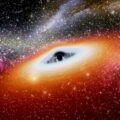
After identifying galaxies, the team moved on to searching for curves in space produced by dark matter, revealed in the curves detected in light traveling to Earth from distant galaxies, similar to when light moves through warped glass.
“This is the largest dark matter map we’ve made with Webb, and it’s twice as sharp as any dark matter map made by other observatories,” said co-lead author Dr Diana Scognamiglio, of NASA’s Jet Propulsion Laboratory. “Previously, we were looking at a blurry picture of dark matter.”
“Now we’re seeing the invisible scaffolding of the Universe in stunning detail, thanks to Webb’s incredible resolution,” Scognamiglio said.
The paper, “An Ultra-High-Resolution Map of (Dark) Matter,” appeared in Nature Astronomy on January 26, 2026.
Ryan Whalen covers science and technology for The Debrief. He holds an MA in History and a Master of Library and Information Science with a certificate in Data Science. He can be contacted at ryan@thedebrief.org, and follow him on Twitter @mdntwvlf.