
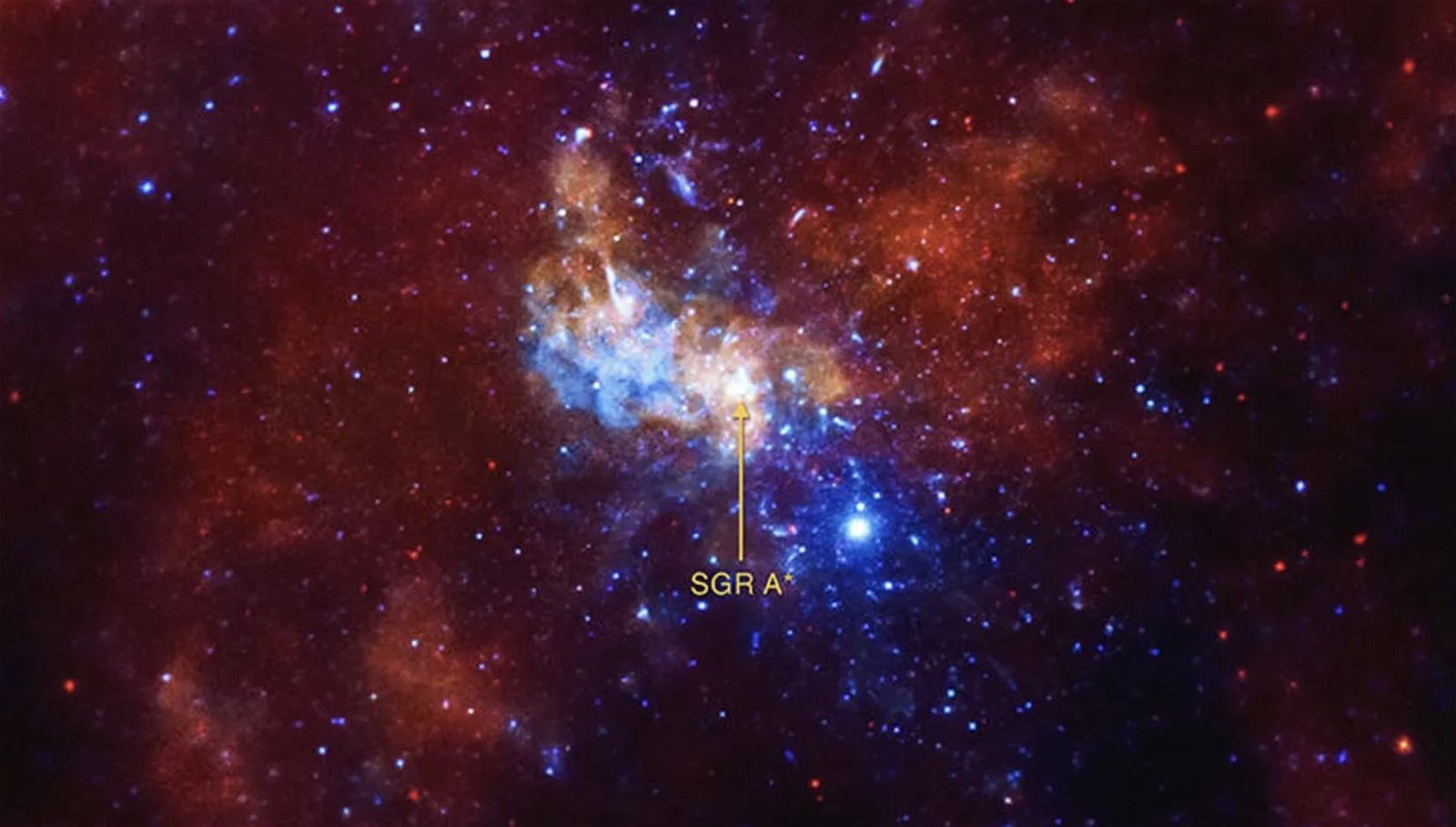
An international team of astronomers led by the Infrared/Submillimetre Group at the Max Planck Institute for Extraterrestrial Physics (MPE) has announced the discovery of a star so close to Sagittarius A*, the Milky Way’s centrally placed supermassive black hole, that it is experiencing warped spacetime.
With a highly elliptical orbit around Sagittarius A* of only 8.7 years, the newly named S301 comes as close as Saturn does to our Sun during its nearest approach. The research team said this close approach makes it the star with the shortest recorded orbital period and the tightest ever observed in the galaxy’s center.
Black Hole-Orbiting Star Experiencing Warped Spacetime
In a statement emailed to The Debrief, Reinhard Genzel, Director at MPE and Nobel Laureate for Physics in 2020, noted that S301’s historically tight orbit around Sagittarius A* is ten times closer to the Galactic Center than “our previous best star.”

Along with that record, the team said the star’s tight orbit also moves it through a region of space where the black hole’s extreme gravitational pull “drags spacetime itself.”
Genzel noted that “S301 probes spacetime in the Galactic Center,” a phenomenon that astrophysicists believe only occurs in the immediate vicinity of a massive, spinning object like a black hole.
According to the MPE team, the evidence for this warped spacetime shows up in the star’s orbital path. Specifically, they said the star’s path “deviates significantly” from the path predicted by Newton’s classical theory of gravitation.
“This is a clear sign of relativistic effects that occur only in the vicinity of a massive, rotating black hole,” the researchers explained.

The Physics Behind the Phenomenon
To explain the evidence of warped spacetime, the MPE team said two scientific principles are at work. The first, called Schwarzschild Precession, occurs when space itself is curved around a central mass. In the case of S301, the object creating an extended field of warped spacetime around it is the supermassive black hole Sagittarius A*.
“The Schwarzschild solution of general relativity remains a useful approximation to explain the orbit of S2, even for a spinning black hole at the center of the Galaxy,” they explained.

The second relativistic mechanism causing the warped spacetime drag on S301 is called the Lense-Thirring effect. Specifically, the massive black hole exerts a separate force from Schwarzschild Precession due to its rotation.
“A rotating mass, in a sense, drags the surrounding space-time along with it – much like a rotating spoon setting the water in a cup in motion,” the MPE team explained.
Unlike the more powerful effect of gravity, the team said the effect on the star caused by the rotation of Sagittarius A* is “significantly weaker and therefore more difficult to detect.” This rarity marks the team’s observation of the effect, another historic first.
“S301 is the first star to orbit directly in the region around Sagittarius A* where the frame-dragging effect is extreme,” explained Felix Mang, PhD student at MPE and corresponding author of the study. “We’re not just measuring spacetime curvature; we are measuring how it gets distorted by the rotation of the black hole itself. That is unique.”
“Explore Strange New Worlds, Seek Out New Physics, and See What Nobody Has Seen Before”
Astronomers first identified S301 in spring 2023 using the GRAVITY instrument at the Very Large Telescope Interferometer (VLTI) of the European Southern Observatory (ESO) in Chile. Unlike conventional observatories, GRAVITY observes targets simultaneously with four 8-meter telescopes. The light is then combined into a single image, resulting in an angular resolution 40 times sharper than images captured by a single telescope.

“GRAVITY’s exceptional resolution makes it possible to observe stars at the center of the Milky Way on scales comparable to the size of our solar system, even when they are extremely faint,” the MPE team explained, adding that “this unprecedented combination of precision and sensitivity has made it possible to detect S301, a new and extremely faint star.”

When discussing the next steps in the investigation of the star experiencing warped spacetime, the MPE team noted that a recent upgrade to the facility, GRAVITY+, which includes a new adaptive optics system and laser guide stars, “has increased the instrument’s sensitivity by a factor of 10 to 100.” Genzel said the upgrade will lead to even more discoveries in a relatively short time.
“Within the next decade, we will measure the black hole’s rotation directly — a milestone for general relativity,” The researcher explained.
Frank Eisenhauer, director at MPE and Principal Investigator of the GRAVITY and GRAVITY+ projects, said the opportunity to discover “the beauty of nature” in the form of S301 “is truly a dream come true.” The researcher also pointed to future observations and the new tools that will make them possible, while seemingly harkening back to a popular 1960s TV show introduction championing the exploration of space.
“GRAVITY+ and the upcoming MICADO instrument, currently being developed in an international consortium led by MPE for the ESO Extremely Large Telescope [will help us] to explore strange new worlds, seek out new physics, and see what nobody has seen before.”
The study “Discovery of a star sensitive to the spin of Sagittarius A*” was published in Nature.
Christopher Plain is a Science Fiction and Fantasy novelist and has spent the last six years as Associate News Editor and Head Science Writer at The Debrief. Follow and connect with him on X, learn about his books at plainfiction.com, or email him at christopher@thedebrief.org.