

NASA engineering teams are preparing for the launch of the Nancy Grace Roman Space Telescope, which will soon begin the first phase of its historic mission to help scientists unlock the mysteries of dark energy.
On Wednesday, the American space agency reported that the completed telescope, presently contained within its payload fairing, has been transported from NASA’s Payload Hazardous Servicing Facility to a SpaceX hangar located at the famous Launch Complex 39A at NASA’s Kennedy Space Center.
If all goes according to plan, the telescope will be launched aboard a SpaceX Falcon Heavy rocket at 7:26 a.m. EDT this Sunday, Aug. 30.
What Roman’s Science Tool Kit Includes
The telescope’s unique science instruments make Roman a different breed of space observatory from its predecessors, like the James Webb Space Telescope and Hubble Telescope, as they are designed with the special focus of advancing the search for dark energy.
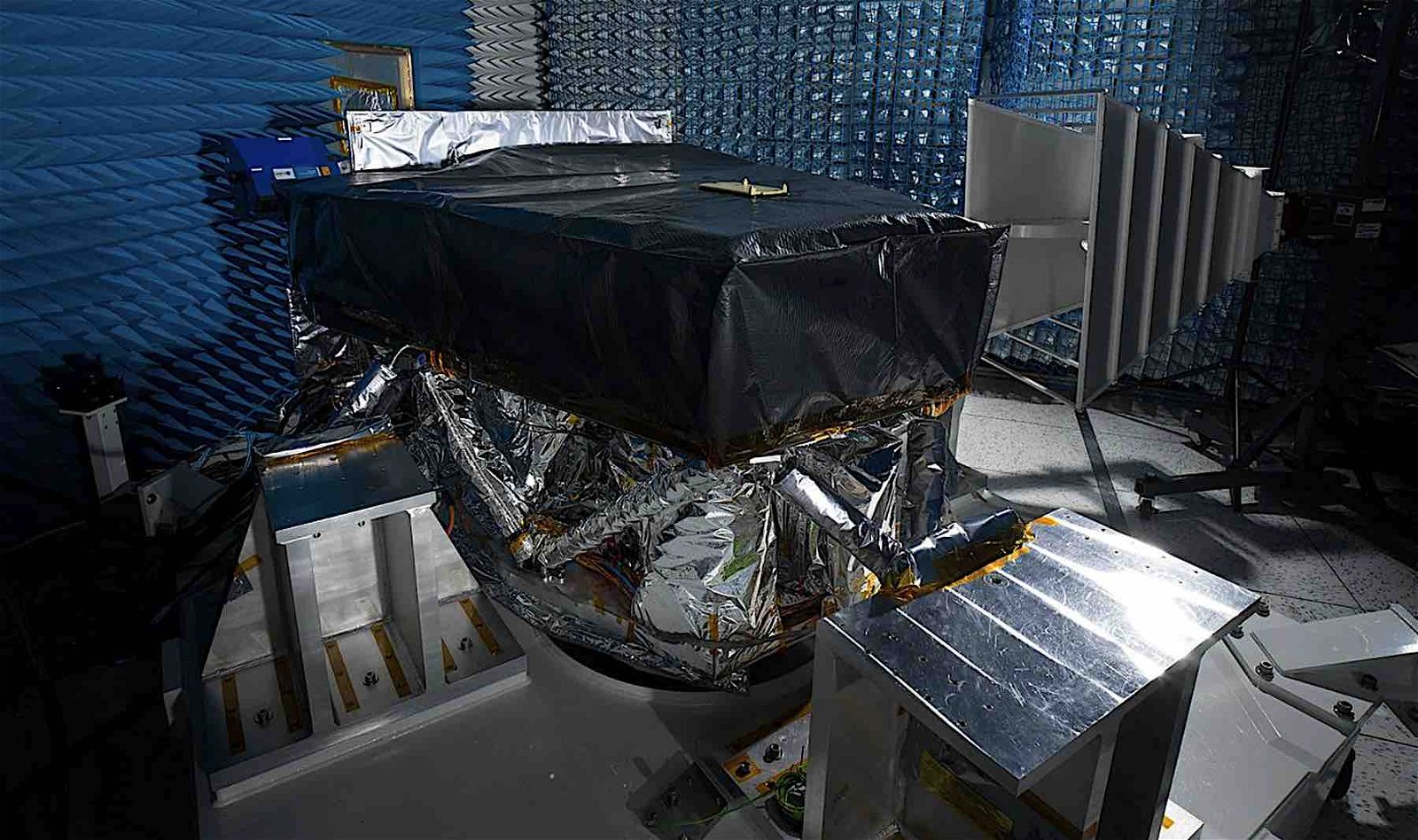
Roman is equipped with two primary capabilities, which involve its Wide Field Instrument (WFI) and Coronagraph Instrument. With a 300-megapixel, near-infrared camera designed for large area image capture and spectroscopy, the WFI will enable astronomers to observe a 0.281 square degree field of view and includes a special imaging mode with two slitless spectroscopy modes.
“The instrument provides a sharp point spread function, precision photometry, and stable observations for implementing the Dark Energy, Exoplanet Microlensing, and NIR surveys,” according to a NASA FAQ page detailing Roman’s primary instrument.
Exoplanet Imagery and Spectroscopy
Meanwhile, the telescope’s Coronagraph Instrument also features both imaging and spectroscopy modes, with capabilities fine-tuned for imaging exoplanets.
“The Coronagraph will be the first instrument on a space telescope to make use of numerically optimized, precision-fabricated coronagraph masks,” NASA’s FAQ page reads. This will be achieved by employing a combination of deformable mirrors that will enable high-order wavefront control, a low-order wavefront sensing and control system, and finally, CCD detectors designed for electron multiplication and counting low-flux photons.

A Next-Generation Space Observatory Prepares for Launch
Along with its search for dark energy and exoplanets, Roman will also provide NASA and researchers around the world with an unprecedented opportunity to study the formation of galaxies and the way that dark matter governs their evolution over time.
NASA will begin live coverage of Roman’s launch on Sunday morning at 6:20 a.m. Eastern Time, and you can follow the updates online with NASA’s free streaming platforms.
Micah Hanks is the Editor-in-Chief and Co-Founder of The Debrief. A longtime reporter on science, defense, and technology with a focus on space and astronomy, he can be reached at micah@thedebrief.org. Follow him on X @MicahHanks, and at micahhanks.com.