
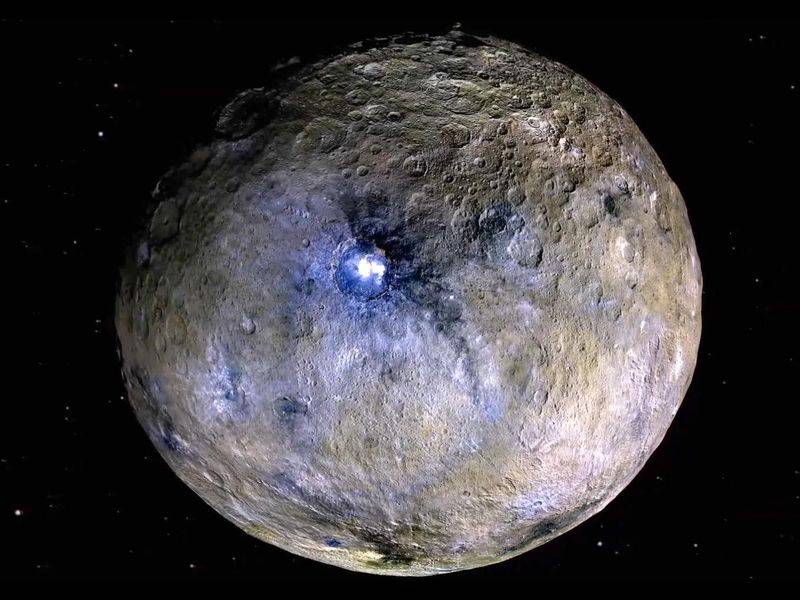
Deep within the dwarf planet Ceres, situated in the asteroid belt between Mars and Jupiter, a chemical energy source once existed that may have made the now-cold planet habitable in the distant past.
While no direct evidence for microorganisms has been identified on Ceres today, the new findings, published in Science Advances, support the theory that the dwarf planet may once have been capable of supporting simple, single-celled life. The supporting data was obtained by NASA’s Dawn mission, which, despite ending in 2018, continues to provide rich information that scientists are still exploiting.
Dawn and Life on Ceres
Earlier analysis of the Dawn mission data provided scientists with a more comprehensive picture of Ceres, suggesting that the dwarf planet may contain several essential elements necessary for life as we know it. The first observation was of bright, reflective areas on the surface, identified as salts deposited by liquids rising to the surface from within the dwarf planet.
As scientists continued to explore the Dawn observations, they discovered a massive brine reservoir hidden beneath the surface, containing large quantities of salty water. Additionally, researchers located organic carbon molecules—a key component of microbial life.
While these individual components were interesting and helped build a hopeful case for past habitability, one missing puzzle piece would be required to truly call Ceres “habitable”: energy.
Now, in identifying a source of chemical energy on the dwarf planet, the team has finally located a way for life to have been sustained.
Modeling an Ancient World
The scientists behind the new study developed detailed chemical and thermal models of Ceres as it would have existed roughly 2.5 billion years ago. These models tracked the temperature and composition of the dwarf planet’s interior as it changed over time, with dissolved gases being removed from metamorphosed rocks in the dwarf’s core that may have travelled up through the subsurface ocean.
Additionally, decaying radioactive elements in the dwarf planet’s rocky interior could have provided the heat for a continual supply of hot water; a process that astronomers believe is common within our solar system.
“On Earth, when hot water from deep underground mixes with the ocean, the result is often a buffet for microbes — a feast of chemical energy. So it could have big implications if we could determine whether Ceres’ ocean had an influx of hydrothermal fluid in the past,” said lead author Sam Courville, a NASA JPL intern during the study, now at Arizona State University at Tempe.
Past Life
Ceres, as it exists today, is greatly diminished from the once potentially habitable world. It is colder and drier, lacking the radioactive decay that once likely kept large quantities of water in liquid form. The remaining liquid water on Ceres exists only in concentrated brine. Meanwhile, sources of heat such as the internal warming that Saturn’s moon Enceladus and Jupiter’s moon Io experience from the gravitational pull of orbiting a large planet are unavailable to the dwarf planet, which is stranded within an asteroid field.

Only early in Cere’s existence, between a half billion and two billion years after its formation, would the planet still have had the active processes required to sustain life.
The teams’ new results are of great interest to scientists seeking evidence for life beyond Earth, as they open up the possibility that many more moons and dwarf planets may have, at least at some point in their history, been habitable, and that perhaps other water-rich objects in the outer solar system, though lacking gravitational heating, may still warrant interest in the search for extraterrestrial life.
The paper, “Core Metamorphism Controls the Dynamic Habitability of Mid-Sized Ocean Worlds—The Case of Ceres,” appeared in Science Advances on August 20, 2025.
Ryan Whalen covers science and technology for The Debrief. He holds an MA in History and a Master of Library and Information Science with a certificate in Data Science. He can be contacted at ryan@thedebrief.org, and follow him on Twitter @mdntwvlf.