

Welcome to this week’s edition of The Intelligence Brief… This week, NASA has officially confirmed the end of its MAVEN Mars mission after the spacecraft mysteriously fell silent late last year, bringing to a close more than a decade of groundbreaking research at the Red Planet. In our analysis, we’ll be looking at 1) how MAVEN unexpectedly lost contact with Earth after a routine orbital maneuver behind Mars, 2) the newly revealed explanation involving an apparent uncontrolled spin that drained the spacecraft’s power reserves, 3) the scientific legacy MAVEN leaves behind after transforming our understanding of the Martian atmosphere and serving as a vital communications relay, and 4) what the loss of one of NASA’s flagship Mars missions means for future exploration as other orbiters continue the search for discoveries.
Quote of the Week
“The science MAVEN has given us is key to informing what kind of radiation protection and safety measures we must take before sending humans to Mars.”
– Louise Prockter, Director, Planetary Science Division at NASA Headquarters, Washington
If you enjoy the news and perspectives offered by The Debrief, make sure that you aren’t missing our stories by making us one of your “preferred sources” on Google News. You can simply follow this link to add The Debrief to your list of favorites, and you can read more about Google’s preferred sources in our article here.
RECENT NEWS from The Debrief
- Physicists just tried cutting a photon in half—and things got really weird.
- A new mathematical model is offering a warning of how fast Earth’s limits could reshape human life.
- A massive discovery in northeastern Romania has revealed links to a curious ancient culture.
- An astronomical ‘Rosetta Stone’ could help unravel the origins of mysterious cosmic signals.
- Get all the latest stories from The Debrief, with more breaking stories at the end of this week’s newsletter.
A Spacecraft Goes Missing
Late last year, NASA officials made a startling announcement: the American space agency had lost contact with one of its spacecraft that had been orbiting Mars for more than a decade.
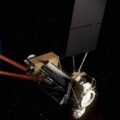
The story began unfolding in the early days of December 2025, when NASA’s Mars Atmosphere and Volatile EvolutioN (MAVEN) spacecraft abruptly ceased communications. For close to a decade prior, the MAVEN mission had been engaged in scientific studies that helped planetary scientists understand aspects of the Martian upper atmosphere.
Before the sudden radio silence last year, MAVEN appeared to be communicating fine with mission specialists. However, following the spacecraft’s routine dip behind the red planet, the spacecraft ceased its normal radio communications after reemerging on the other side.
At the time of the incident, NASA officials announced that investigations were underway to determine what might have happened to one of its flagship Mars spacecraft.
Now, months after communications were initially lost, NASA has finally issued an official update about the future of the MAVEN mission.
MAVEN: The End of an Era
Now, after six months of silence, NASA officials have confirmed that the spacecraft is no longer operational.
In a statement issued on Wednesday, the mission’s conclusion was officially announced, along with the revelation that the spacecraft is believed to have entered an unusually fast speed while transiting the far side of Mars last December, a maneuver which caused deviations from its normal orbit.
During this period of orbital confusion, the spacecraft’s power stores were drained as the onboard batteries were impacted by the unexpected spin.
According to officials who spoke on Wednesday, a review board was convened earlier this year to determine whether there was any path forward, but ultimately concluded that the spacecraft could not be recovered in its present state.
NASA investigations continue to search for additional clues to what specifically might have induced the spin that led to the spacecraft’s demise.
MAVEN’s Legacy
During its time in operation over the last decade, MAVEN has provided a wealth of useful data about the Martian atmosphere. This includes important data about Martian weather systems, in addition to helping relay data back to Earth from NASA’s two ground-based robotic rovers, Curiosity and Perseverance.
Last year, while the enigmatic interstellar comet 3I/ATLAS was making its way past Mars, MAVEN was also instrumental in helping collect data about the unusual visitor, even during what became the longest U.S. government shutdown in history.
Speaking this week as the conclusion of the mission was officially announced, MAVEN lead scientist Shannon Curry of the University of Colorado Boulder offered praise, noting that the now defunct orbital craft “has truly advanced our understanding of the Martian atmosphere and evolution.”
Fortunately, MAVEN wasn’t alone: NASA’s Mars Reconnaissance Orbiter and the Mars Odyssey spacecraft both remain operational, and are expected to continue sending information back to NASA scientists about ongoing Martian discoveries in the years ahead.
That concludes this week’s installment of The Intelligence Brief. You can read past editions of our newsletter at our website, or if you found this installment online, don’t forget to subscribe and get future email editions from us here. Also, if you have a tip or other information you’d like to send along directly to me, you can email me at micah [@] thedebrief [dot] org, or reach me on X: @MicahHanks.

Here are the top stories we’re covering right now…
- Look What NASA Captured in Satellite Images as This Bizarre Phenomenon Erupted from the Heart of a Super Typhoon
A violent typhoon that tore across the North Pacific Ocean in April offered a rare look at an unusual spectacle of the natural world, captured in nighttime imagery by a U.S. satellite. - Stonehenge Mystery Deepens as New Study Reveals Altar Stone’s 466-Mile Journey Across Ancient Britain
New study reveals how Stonehenge’s Altar Stone may have traveled hundreds of miles across prehistoric Britain before arriving at the monument. - In Antarctica, Scientists Just Discovered a Massive Hidden Structure Deep Below the Frozen Surface
A massive, semi-continent-sized subsurface structure has been discovered by scientists beneath Antarctica’s frozen surface. - A Black Hole Mystery That Has Puzzled Scientists for Half a Century Has Finally Been Solved
A black hole mystery has been solved after half a century, after researchers discovered evidence of a long-missing cosmic wind. - “A Holy Grail of Integrated Photonics”: EPFL Researchers Reveal Tiny-Yet-Powerful Ultrafast Laser on a Chip
Scientists have revealed a downscaled, lab-sized, high-energy ultrafast laser to the size of a matchhead, enabling futuristic technologies. - 1 Out of 4 Americans Say They’ve Had Near-Death Experiences, According to Major Survey
Near-death experiences (NDEs) might be more common than most would think, according to a groundbreaking new study. - One of America’s Rarest Species Just Narrowly Survived a Historic Wildfire—NASA Satellite Images Reveal the Stunning Damage
NASA satellite images reveal recent damage on Santa Rosa Island from what officials say was the largest Channel Islands wildfire on record. - Can AI Be Conscious? Researchers Say Science May Not Yet Know How to Tell
Common experimental methods in consciousness research don’t separate subjective experience from general information processing, new research argues. - Scientists Just Revealed Something Massive Has Been Hiding Beneath This New York Cemetery for More Than a Century
Cornell University researchers have confirmed a massive, century-old underground discovery hidden below a New York cemetery. - Exoplanet Magnetism Revealed in New Study Researchers Call a “Key Step” in Decoding the Survival of Planets
The best evidence for exoplanet magnetic fields ever discovered has emerged from new research that measures wind speeds on ultra-hot Jupiters. - “Explore a Scene from Any Vantage Point You Want”: 3D Volumetric Video Breakthrough Means Streaming in 3D May Soon Be a Reality
A 3D volumetric video breakthrough, overcoming previous technological limitations, could finally enable true 3D streaming on everyday devices. - “How in the World Can These Things Happen?”: After a Series of ‘Mystery’ Quakes Shook Utah, Scientists Finally Think They Know Why
Nearly five decades after the first in a series of mystery quakes rocked the Utah-Wyoming region, scientists think they’ve figured it out. - Astronomers Discover New Way to Weigh Planets Hidden Inside Dusty Disks
Newborn planets’ dusty rings hold the secret to uncovering their mass, say researchers who have now characterized these once-obscured celestial objects. - A Single Jawbone From Egypt Is Changing How Scientists Think About Ape Origins
For much of the past century, fossils from East Africa have shaped our understanding of ape evolution. Now, a jawbone found in the Egyptian desert adds a new dimension to that story. - Pavlov’s Mosquito: Pests Can Be Conditioned to See DEET as a Meal Ticket Instead of a Deterrent
Mosquitoes may have surprisingly overcome one of humanity’s best defenses against them, associating the smell of DEET with a nearby meal. - Einstein-Rosen Bridges May Not Be Wormholes After All, Physicists Reveal
Recent research suggests that the original bridge theory was not a wormhole but a mathematical feature of how time is structured.