
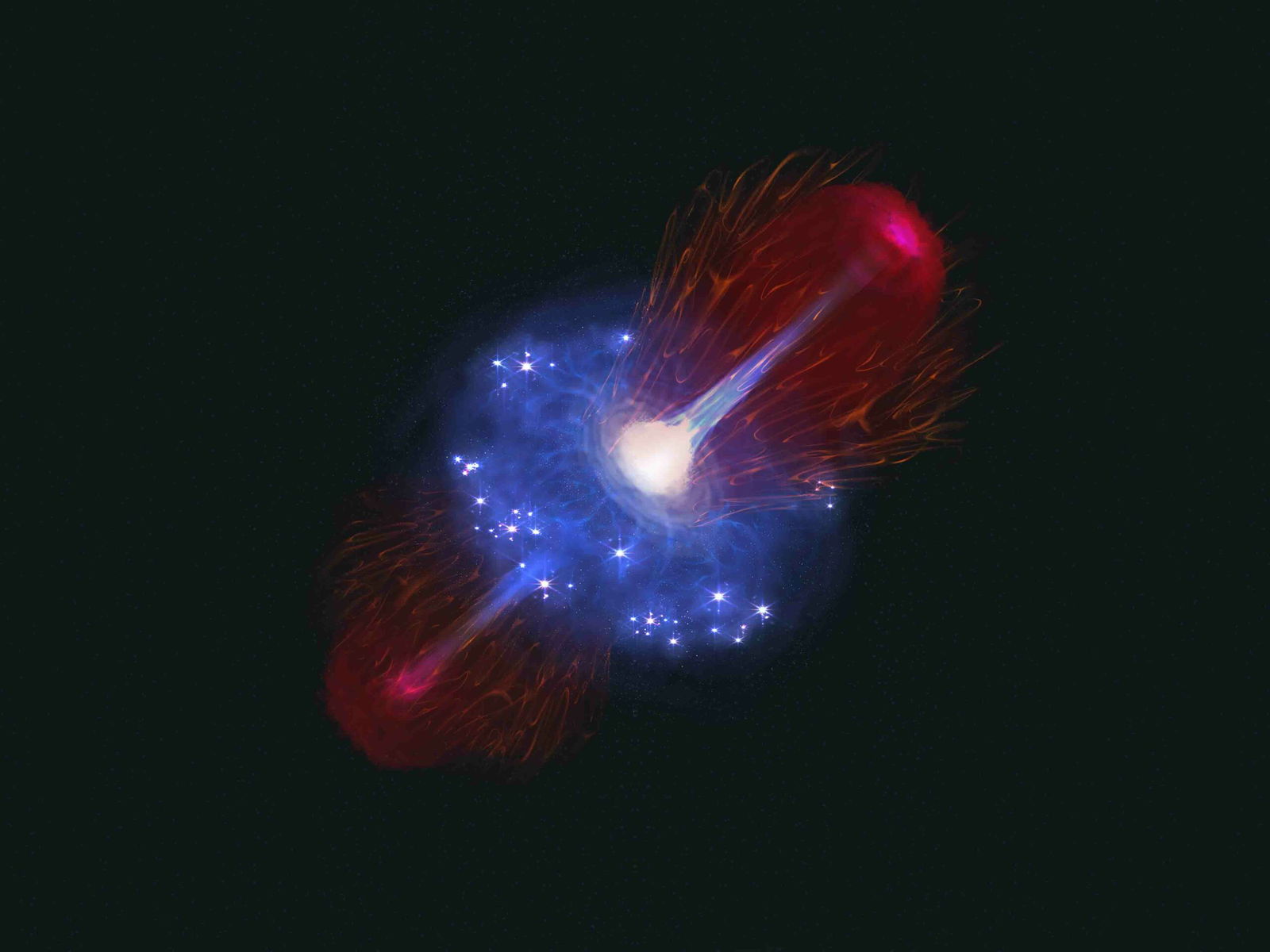
Astronomers have discovered the longest gamma-ray burst ever recorded, revealing that a black hole literally consumed a star from the inside out over the course of seven hours.
The event, dubbed GRB 250702B, was first detected on July 2, 2025, when NASA’s Fermi Gamma-ray Burst Monitor captured signals spanning approximately 25,000 seconds, or nearly seven hours. This shattered the previous record held by GRB 111209A, which lasted 15,000 seconds, making the new discovery the most prolonged gamma-ray burst in astronomical history.
A team of over fifty scientists published a new paper on the arXiv preprint server that examines this curious cosmic event, and their findings indicate some wild black hole behaviour.
A Cosmic Force of Unprecedented Power
Gamma-ray bursts are among the most powerful explosions in the universe, typically lasting anywhere from fractions of a second to a few minutes. These cosmic fireworks usually fall into two categories: short bursts linked to neutron star collisions, and longer ones connected to the collapse of massive stars called collapsars.
But GRB 250702B defied classification. Compared to other observed bursts, it emitted an incredibly powerful amount of energy. In reference to other similar events, this one should have been quick due to the amount of energy being expelled. The burst displayed an unusually hard spectrum and high peak energy, with rest-frame photons reaching above 10 MeV, far exceeding typical gamma-ray burst energies.
In simple terms, it was a big boom, which means it should have been over quickly. Except it wasn’t.
High Energy and “Extreme Duration”
“We find a hard spectrum, subsecond variability, and high total energy, which are only known to arise from ultrarelativistic jets powered by a rapidly-spinning stellar-mass central engine,” the international team of over 50 scientists reports in their study. “These properties and the extreme duration are together incompatible with all confirmed gamma-ray burst progenitors.”
The research team systematically eliminated every known mechanism for producing gamma-ray bursts. Standard “collapsar” models failed because there’s a physical limit to how long a collapsing star can maintain the rotation needed to power such events. At the observed duration, a star would simply spin apart.
Other possibilities fell short for different reasons. Neutron star mergers and magnetar giant flares couldn’t sustain emissions for long enough. White dwarf mergers and various types of stellar collisions were ruled out because they would predict peak energy output early in the event, contradicting the significant delay to peak power observed in GRB 250702B.
Even the possibility of a supermassive black hole tearing apart a star was eliminated. While such events can last for days, they occur at galaxy centers and exhibit much slower variability compared to the rapid fluctuations seen in GRB 250702B. Crucially, follow-up observations confirmed that GRB 250702B originated from a star-forming region offset from its host galaxy’s center, not the nuclear region where supermassive black holes reside.
A New Model Emerges
Tossing conventional explanations aside, the team turned to an exotic scenario: the helium merger model. This process begins with a binary star system where one star has already collapsed into a black hole while its companion continues burning fuel and expanding.
As the companion star swells during its normal stellar evolution, it can grow so large that it engulfs its black hole partner. The black hole then begins a deadly spiral inward through the star’s outer layers, losing orbital energy through friction and tidal forces until it reaches the dense helium core at the star’s center.
Once there, the black hole doesn’t simply devour the core quickly. Instead, the extreme angular momentum from the collapsed orbit creates an accretion disk around the black hole. This disk generates the powerful magnetic fields necessary to launch the ultrarelativistic jets that produce gamma rays, while viscous processes in the disk drive strong stellar winds.
“The angular momentum lost from the orbit goes into the helium star and when the black hole reaches the center of the core, this high angular momentum will cause the helium core to accrete through a disk,” the researchers explain. “This disk can produce the magnetic fields required to drive jets and viscosity in the disk will drive strong winds.”
As this consumption occurs, the star will supernova, creating an engine that pushes the gamma-ray burst out into the cosmos, much like with collapsars.
This discovery represents a new window into stellar death and binary evolution. The helium merger model connects several areas of astrophysics that were previously thought to be separate, potentially linking gamma-ray bursts to gravitational wave sources and unusual types of supernovae.
For space science, GRB 250702B represents a breakthrough in understanding the most extreme physics in the universe. It demonstrates that nature still has surprises in store, even after decades of gamma-ray burst observations.
MJ Banias covers space, security, and technology with The Debrief. You can email him at mj@thedebrief.org or follow him on Twitter @mjbanias.