

While comet 3I/ATLAS and its dusty tail remain far out of the reach of Earthly spacecraft, astronomers say the unusual interstellar object has produced a secondary “hidden” trail of charged particles marking its path through our solar system.
Now, a pair of scientists with the European Space Agency (ESA) has proposed a bold idea: it may be possible to sail a pair of NASA and ESA spacecraft through the mysterious visitor’s “ion tail.”
The idea was advanced by a pair of researchers in a new paper, which argues that the trajectory of NASA’s Europa Clipper spacecraft and the European Space Agency’s (ESA) Hera spacecraft could allow them to pass directly through the trail of ions left in 3I/ATLAS’s wake.
Doing so might offer astronomers a rare opportunity to collect samples of material from other worlds, which the odd interstellar comet has ejected during its unprecedented visit.
Mission Into an Interstellar Object’s Odd “Ion Tail”
Between October 30 and November 6, 2025, the trajectories of the Europa Clipper and Hera space missions may briefly align with the ion trail left by 3I/ATLAS, allowing their instruments to collect information through detections of charged particles carried outward from the object by the solar wind.
“During the period 30 October – 6 November 2025, it is predicted that Europa Clipper will potentially be immersed within the ion tail of 3I/ATLAS, providing the opportunity to detect the signatures of an interstellar comet’s ion tail, write authors Samuel Grant and Geraint Jones in their paper, which appeared on the preprint arXiv.org server on October 15, 2025.
“Characteristic changes to the solar wind are also expected to be observed,” the authors say, which will likely include what they characterize as “a magnetic draping structure” potentially emanating from the comet.
Even prior to Europa Clipper’s potential passage through the mysterious ion tail of 3I/ATLAS, Grant and Jones believe that the ESA’s Hera spacecraft “will possibly be immersed within the ion tail of 3I/ATLAS during the period 25 October – 1 November 2025.”
Neither spacecraft will be endangered during their potential transit of the interstellar comet’s tail of charged particles, although the implications of doing so could end up being profound, in that they may offer the first opportunity to make indirect observations of material samples from another star system.
A Fortuitous Cosmic Alignment
Grant and Jones are uniquely placed to make such predictions about these space missions and their path in the ion wake of 3I/ATLAS, as they are the ESA researchers behind Tailcatcher, a computer model that tracks how packets of solar wind interact with comets.
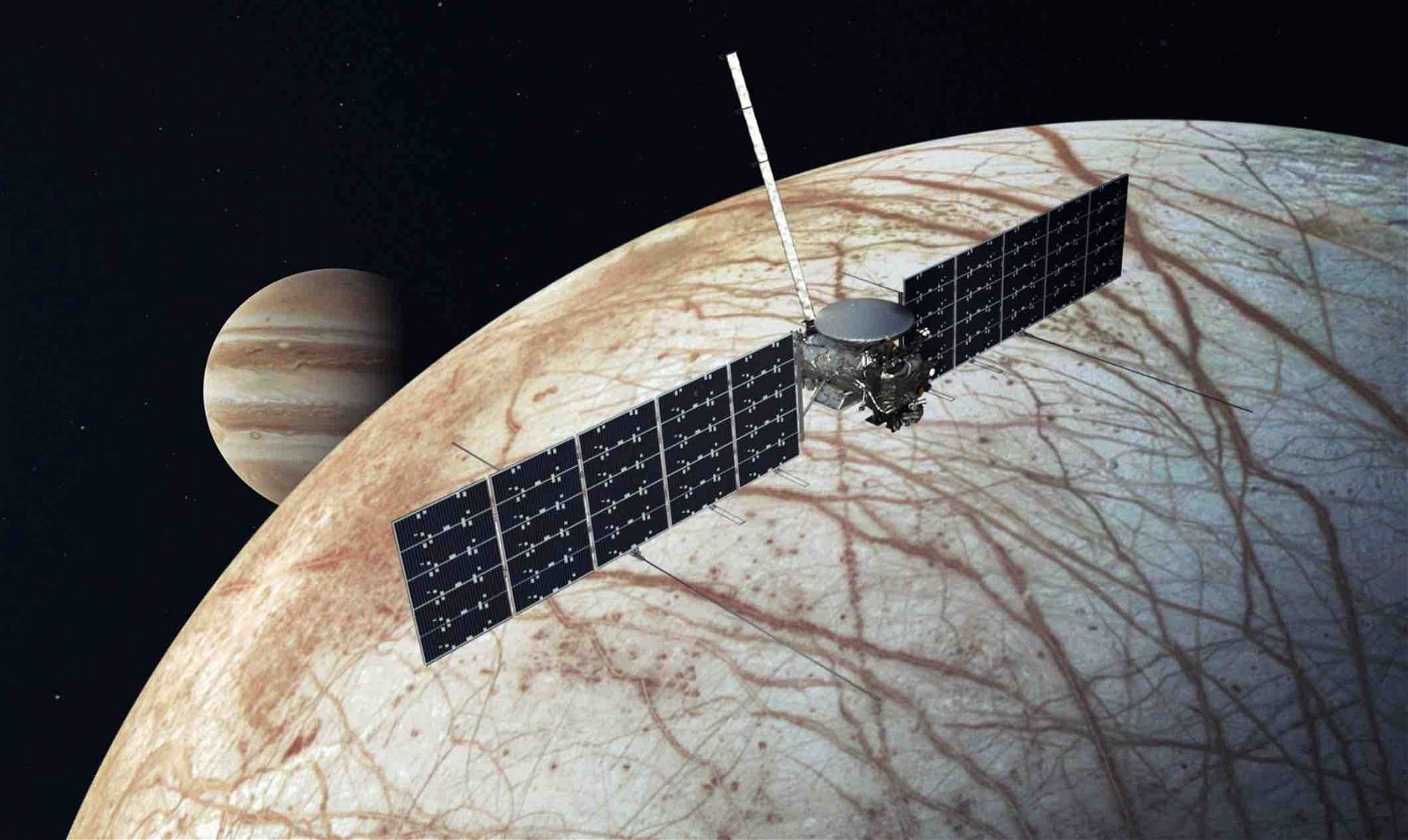
According to their calculations, Europa Clipper may be equipped to detect very subtle changes in the plasma environment in space as the comet’s material sweeps by it, moving at speeds of several hundred miles per second.
The Rarity of Interstellar Visitors
One reason 3I/ATLAS captivates astronomers is its origins beyond our solar system, which likely helps explain several of its odd characteristics. Unlike comets from within our solar system, objects like 3I/ATLAS and its predecessors 2I/Borisov and 1I/Oumuamua hail from stars in vastly distant regions in space, and therefore carry with them material they obtained during these interactions that occurred eons ago.
Because of this, current observations about 3I/ATLAS estimate that it is not only the fastest comet ever observed by astronomers, but also potentially the oldest they have ever seen.
Given their rarity, we have been able to collect virtually no data about the composition of these interstellar objects. All the information we have comes from telescopic observations or those made using camera systems on board various space probes, like those currently orbiting Mars.

As recent attempts at visualizing 3I/ATLAS have shown, at times these observations can prove to be especially challenging—not to mention the fact that amid the U.S. government shutdown, NASA has been unable to release what could be some of the most important visuals yet obtained of 3I/ATLAS, believed to have been made by the HiRISE camera aboard the Mars Reconnaissance Orbiter (MRO) earlier this month.
3I/ATLAS’s “Hidden” Tail
Like the interstellar object itself, the dust trail produced by 3I/ATLAS is also well out of reach of any current space missions. However, the same can’t be said of the ionic tail the object produces while being bombarded by solar winds during its approach near the Sun.
Driven by this constant and extremely powerful flow of highly charged particles that disperse throughout our solar system from the Sun, particulates ejected from 3I/ATLAS, apart from the dusty material that immediately surrounds it, are carried away from the object in the same direction as the solar wind, producing a secondary ion tail.
Given the challenges that collecting data about these objects presents, an opportunity to sample ions left in its tail of highly charged particles, even indirectly, could provide us with the closest look at the chemistry of an alien solar system that astronomers have ever obtained.
A Missed Opportunity?
It is frustrating, therefore, that amid the ongoing U.S. government shutdown, Europa Clipper currently remains in cruise mode as it makes its way toward Jupiter and may not be able to activate its scientific instruments before this rare encounter approaches.
Hence, while we await seeing whether the MRO’s HiRISE camera was able to obtain imagery of 3I/ATLAS in its near approach to Mars on October 3, it also remains in question whether the Europa Clipper spacecraft could be activated in time for it to collect any data from the ion tail emanating from 3I/ATLAS.

For any useful data to be obtained, precision measurements will be required to discriminate between the interstellar comet’s ions and those emitted by the Sun. Fortunately, there are several ways to identify ions from comets, including the chemicals they contain, such as those related to water. In contrast, ions originating from the Sun can be expected to exhibit more helium.
Even if Europa Clipper manages to engage the ion tail of 3I/ATLAS with its instruments in operational mode, astronomers will still have to rely on the solar winds flowing strongly enough and in the right direction at the time of the encounter. Even a relatively minor angular deviation could result in the ionic stream coming from 3I/ATLAS missing the spacecraft entirely.
Hope on the Horizon
However, one promising aspect of the idea proposed by Grant and Jones is that 3I/ATLAS will reach its closest approach to the Sun, known as perihelion, on October 29. This happens to occur just prior to the predicted alignment with Europa Clipper’s path, and as the comet’s activity peaks as it nears the Sun, the ionic tail it produces will widen, which increases the chances that it may be able to detect material being ejected from it.
Additionally, the ESA’s Hera spacecraft may also pass through the solar wind streams carrying material from 3I/ATLAS between late October and November 1. However, unlike Europa Clipper, Hera is not equipped with the scientific instruments capable of measuring any charged particles it encounters.
Even if astronomers miss out on this exciting opportunity, the Tailcatcher mission has already succeeded in predicting an ion tail crossing in 2020 that led to the ESA’s Solar Orbiter detecting particles from comet C/2019 Y4. While 3I/ATLAS will likely remain out of range of such spacecraft, Tailcatcher may be able to make additional predictions based on future visits by interstellar objects that visit our solar system.
Additionally, in 2029, the ESA’s Comet Interceptor will take its position in space to await future candidates that may include an interstellar object similar to 3I/ATLAS and its predecessors, which can be targeted for a close flyby that could obtain far more than just detections of ions pulled away from the object by the solar wind.
In the near term, the upcoming alignment between 3I/ATLAS and NASA’s Europa Clipper mission offers a tantalizing advance look at future discoveries astronomers hope to be able to look forward to in the coming years, at the very least.
Or, if NASA can resume operations in time—along with the rest of the U.S. federal government and its workforce—in the days ahead, Europa Clipper may be uniquely positioned for a chance to collect information about the faint chemical fingerprints of another world.
Grant and Jones’ recent paper, “Prospects for the Crossing of Comet 3I/ATLAS’s Ion Tail,” was uploaded to the preprint server arXiv.org on October 15, 2025.
Micah Hanks is the Editor-in-Chief and Co-Founder of The Debrief. A longtime reporter on science, defense, and technology with a focus on space and astronomy, he can be reached at micah@thedebrief.org. Follow him on X @MicahHanks, and at micahhanks.com.