

Roman soldiers living along Britain’s northern frontier used communal bath and toilet facilities that depended on a sewer system to remove waste from their fort. However, new research indicates that these sanitation efforts were not enough to prevent the spread of intestinal parasites.
The findings, published in the journal Parasitology, provide new insight into daily life at one of the Roman Empire’s most remote military outposts. They also show that infrastructure by itself was not enough to ensure public health, a lesson that remains relevant today.
A Fort at the Edge of Empire
Vindolanda was an ancient Roman fort just south of Hadrian’s Wall, the defensive barrier built in the early second century to mark the northern edge of Roman Britain. The fort was home to rotating groups of infantry, cavalry, and archers from all over the empire. Archaeologists have found rare and detailed evidence here that shows what daily life was like for Roman soldiers almost 2,000 years ago.
The fort consisted of communal bathing and shared latrine-style toilet facilities. Roman engineers built drainage systems to move waste away, showing advanced urban planning for their time. Despite these efforts, the new study shows that fecal-oral pathogens circulated among the soldiers.
Traces of Infection in an Ancient Sewer
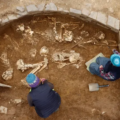
Researchers from the University of Cambridge and the University of Oxford analyzed sediment recovered from a sewer drain connected to a third-century bathhouse latrine at Vindolanda.
The team collected 50 sediment samples from various locations along the drain. In the waste, they also found various ancient Roman artifacts, including pottery, beads, and animal bones.
In the laboratory, researchers used microscopes to look for ancient helminth eggs, which can survive for centuries in moist soil. About 28% of the samples contained eggs from roundworms or whipworms. Both of these parasites spread when food, water, or hands are contaminated with human feces.
One of the samples contained evidence of both roundworms and whipworms. The researchers then used a biomolecular method called ELISA to detect proteins from single-celled organisms. This test identified traces of Giardia duodenalis, a microscopic protozoan parasite that can cause severe diarrheal illness. This is the first time Giardia has been identified in archaeological remains from Roman Britain.
Parasites vs Soldiers
“The three types of parasites we found could have led to malnutrition and caused diarrhoea in some of the Roman soldiers,” said Dr. Marissa Ledger, who led the Cambridge component of the study during her PhD research. “While the Romans were aware of intestinal worms, there was little their doctors could do to clear infection by these parasites or help those experiencing diarrhoea, meaning symptoms could persist and worsen.”
Chronic infections can reduce energy and nutrient levels, which was a serious problem for soldiers who needed to patrol and defend a remote military base. Dr. Piers Mitchell, the study’s senior author, noted that Giardia is especially dangerous during warmer months, when contaminated water can infect multiple people simultaneously.
“Some soldiers could have become severely ill from dehydration during summer outbreaks of Giardia, which are often linked to contaminated water and can infect dozens of people at a time,” Mitchell said. “Untreated giardiasis can drag on for weeks, causing dramatic fatigue and weight loss.”
According to Mitchell, these conditions would have made it easier for other intestinal pathogens, such as Salmonella and Shigella, to spread, potentially causing further outbreaks of disease.
Parasitic Patterns
The results from Vindolanda are similar to parasite patterns found at other Roman military sites, such as Carnuntum in Austria, Valkenburg in the Netherlands, and Bearsden in Scotland. In contrast, Roman cities like London and York show a greater variety of parasites, including tapeworms that are linked to eating undercooked meat and fish.
“Despite the fact that Vindolanda had communal latrines and a sewer system, this still did not protect the soldiers from infecting each other with these parasites,” said Dr. Patrik Flammer of the University of Oxford.
The Relevance of Ancient Parasites
For archaeologists, parasite remains offer a rare biological record of ancient disease. “The study of ancient parasites helps us to know the pathogens that infected our ancestors, how they varied with lifestyle, and how they changed over time,” said Prof. Adrian Smith, who led part of the laboratory analysis at Oxford.
A well-known poem by W. H. Auden describes a Roman soldier facing lice, cold rain, and isolation along Hadrian’s Wall. The evidence from ancient sewer sediments now adds ongoing stomach illness to that list of hardships the soldiers faced.
“These discoveries help us to understand the incredible hardships faced by those posted to this northwestern edge of the Roman Empire nearly 2,000 years ago,” said Dr. Andrew Birley, CEO of the Vindolanda Charitable Trust.
Austin Burgess is a writer and researcher with a background in sales, marketing, and data analytics. He holds a Master of Business Administration, a Bachelor of Science in Business Administration, and a Data Analytics certification. His work combines analytical training with a focus on emerging science, aerospace, and astronomical research.