

For just an hour in late 2019, a cosmic mystery revealed itself to astronomers in an unprecedented way: by bending the light of a star as it passed between Earth and a distant galaxy.
The odd event unfolded on the evening of December 18, 2019, as a star in the Large Magellanic Cloud suddenly—and only for a short time—appeared to become brighter. But what could cause an ordinary star to randomly illuminate in this way, becoming a cosmic beacon for only an hour?
Astronomers considered a few possibilities, the most likely being that some kind of object—and one possessing a significant amount of mass—passed in front of the star, warping its light toward Earth through gravitational microlensing.
Now, the curious object that captured the star’s light for an hour in 2019 has been given a name: Phoebe. Unraveling the mystery as to what it actually was constitutes an intriguing question for astronomers, one which has now been tackled in a recent paper.
Gravitational Microlensing
One of the most fascinating phenomena in modern astrophysics is an effect predicted by Einstein, where gravity itself can act like a lens. The result can often produce beautiful and mysterious cosmic features, which include what astronomers call “Einstein rings” as light from a distant object is warped around a nearer, extremely massive object, taking on a circular or ring-like shape.
A similar effect, known as an “Einstein cross,” produced the even more unusual appearance of multiple objects surrounding a nearer, massive source of lensing.
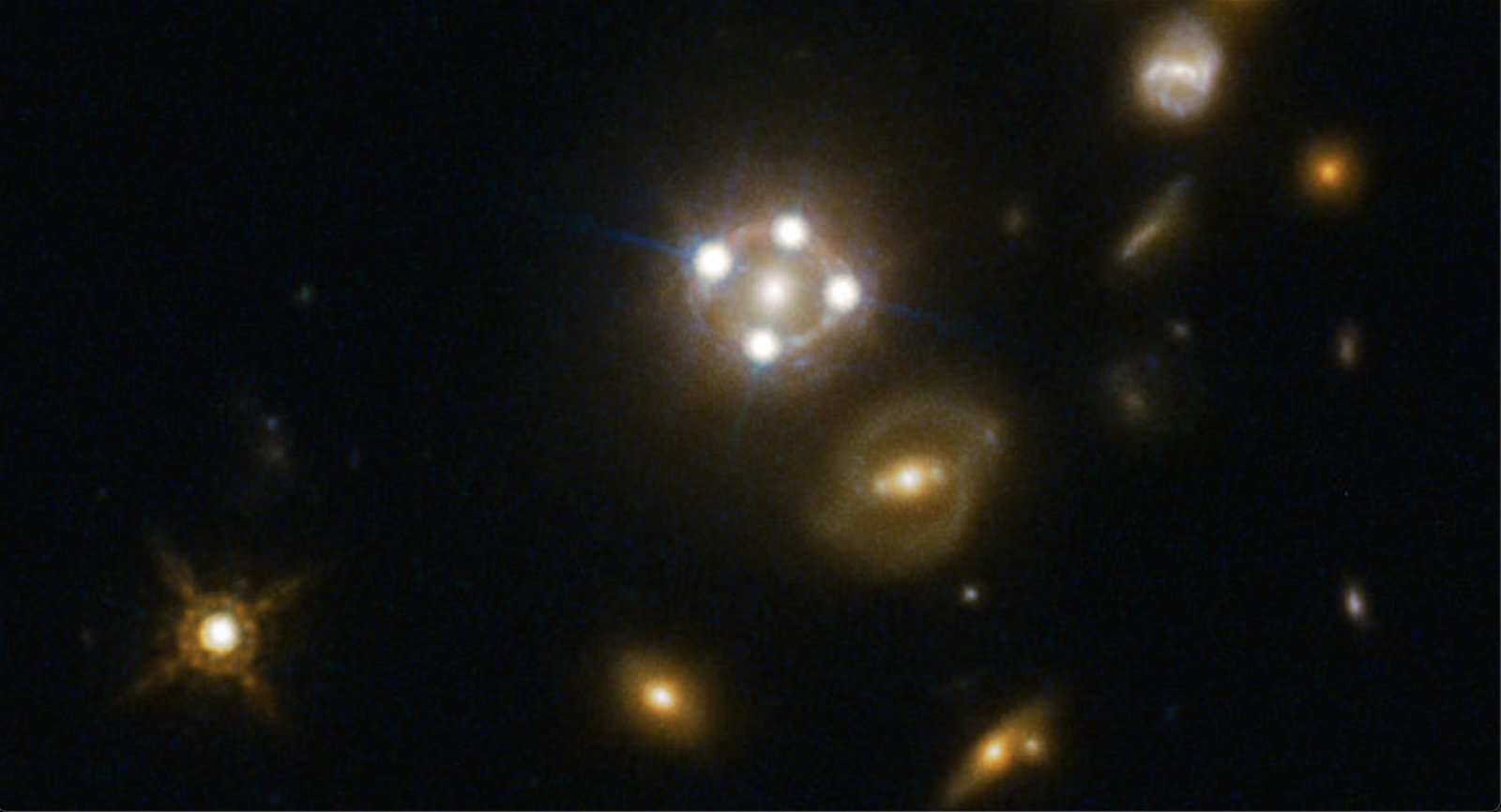
Under most conditions, these objects remain static and can be observed indefinitely. However, in 2019, something very different happened. The light from the star observed in the Large Magellanic Cloud was apparently only subjected to lensing for a short amount of time, meaning that whatever the massive “Phoebe” object was that caused the effect had been in transit.
Possible Explanations
The discovery was revealed as astronomers from Swinburne University in Melbourne spotted Phoebe in the data for a high cadence survey being conducted of the satellite galaxy in question. Now, in a new paper, they propose three possibilities for the mystery object.
One involves a free-floating planet somewhere within the Milky Way, something astronomers also occasionally call “rogue planets.” These cosmic loners come to exist when a planet is ejected from its host system, leaving them to drift through space as lonely planetary wanderers.
Another possibility the team proposes is that the same thing could be going on within the Large Magellanic Cloud itself: a rogue planet originating from that galaxy might have passed in front of the star. If this were ever confirmed, it would mark a notable first, as it would confirm the only extragalactic microlensing planet ever observed by astronomers.
However, a third possibility involves something more unusual: the presence of a primordial black hole, whose origins could go all the way back to the moments immediately after the Big Bang.
Searching for Clues
A major clue to solving the mystery involves the fact that the event took place over just one hour. Given the short duration, it seems most likely that the object was relatively small and therefore able to complete its transit in a short amount of time.
Such a short duration presents challenges for astronomers, since it rests at the threshold of detectability, although the team was able to extract enough information that they could calculate the rough mass of the object, which they believe to have been roughly four times the mass of the moon.

So whatever the object was, it was probably also too small to have been a planet, and also far too small for a normal black hole—the kind produced as a result of stellar collapse—to qualify.
The same couldn’t be said for a primordial black hole, however. Based on additional calculations, the team was also able to demonstrate that Phoebe most likely represents a dark matter object, by around five orders of magnitude greater than other possibilities they looked at.
Overall, this reveals that Phoebe could potentially be one of the oldest objects astronomers have ever spotted, since if its identity as a primordial black hole holds, that would mean its origins go all the way back to the genesis of our universe as we know it.
So based on the team’s work, a star’s mysterious brightening for just one hour in late 2019 might have been even more than an unusual astronomical one-off event: it may have offered us a glimpse at one of the oldest objects in the universe.
The team’s paper, “AMPM II. A Lunar-Mass Primordial Black Hole Microlensing Candidate in the Milky Way Halo,” appeared on the preprint server arXiv.org on May 19, 2026.
Micah Hanks is the Editor-in-Chief and Co-Founder of The Debrief. A longtime reporter on science, defense, and technology with a focus on space and astronomy, he can be reached at micah@thedebrief.org. Follow him on X @MicahHanks, and at micahhanks.com.