
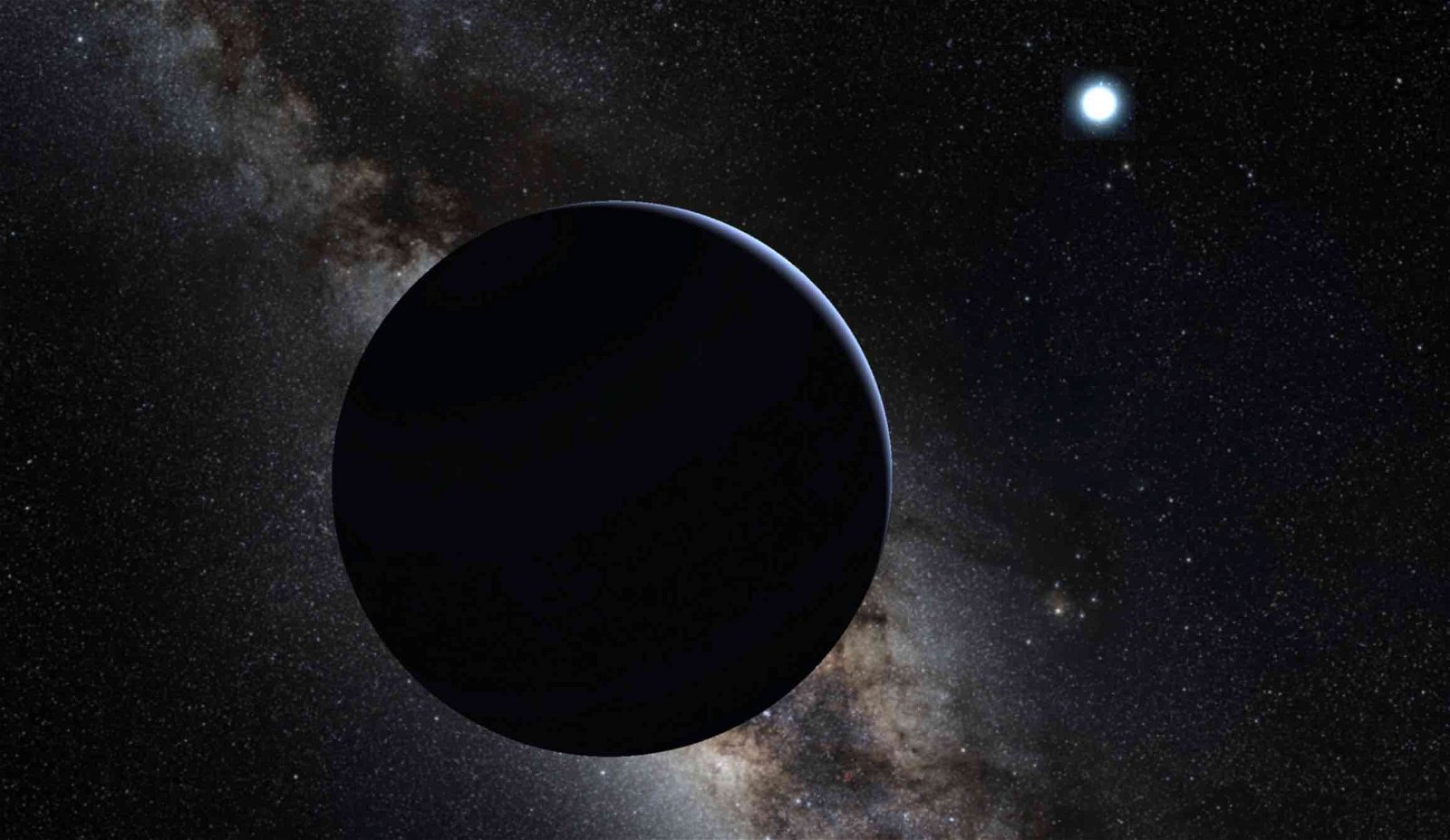
The search for a ninth planet in our solar system could reach a turning point as soon as this year, according to a planetary scientist involved in the hunt for a mysterious object believed to be lurking in the outer reaches of the Solar System.
For the past decade, astronomers around the world have been searching for evidence of another resident in our planetary neighborhood. As far back as 2016, there were already hints that something might be out there, given the odd orbits of distant objects like Sedna, discovered in 2003.
Now, two astronomers—California Institute of Technology (Caltech) researchers Konstantin Batygin, a professor of planetary science, and his colleague, Dr. Michael E. Brown—believe there is a high probability that the confirmation of a ninth planet in our solar system could be on the horizon.
Batygin and Brown’s findings suggest Planet Nine may have a mass roughly 5 to 10 times that of Earth and orbit, on average, about 20 times farther from the Sun than Neptune, which circles the Sun at an average distance of 2.8 billion miles. If it exists, the distant world would take between 10,000 and 20,000 years to complete a single orbit around the Sun.
“This would be a real ninth planet,” says Brown, the Richard and Barbara Rosenberg Professor of Planetary Astronomy, in a 2016 statement. “There have only been two true planets discovered since ancient times, and this would be a third. It’s a pretty substantial chunk of our solar system that’s still out there to be found, which is pretty exciting.”
Evidence for Planet Nine comes from a small group of distant Kuiper Belt objects whose highly elongated orbits appear clustered in the same direction and share similar orbital tilts relative to the plane of the known planets.
Researchers argue that this type of alignment is unlikely to occur by chance. Alternative explanations involving the Kuiper Belt itself have also been explored, but models suggest the belt would require far more mass than has been observed to produce the effect.
Brown’s excitement shines through: “It’s almost like having six hands on a clock all moving at different rates, and when you happen to look up, they’re all in exactly the same place,” he says, adding that the odds of having that happen are something close to one in 100.
Computer simulations suggest that a large, unseen planet in the outer Solar System could maintain these orbital alignments through its gravitational influence. The models also demonstrate how mean-motion resonances could keep the distant objects in stable orbits while preventing collisions with the proposed planet.
The hypothesis may also explain the unusual trajectories of objects such as Sedna and 2012 VP113, whose highly elongated orbits do not bring them close to Neptune.

Japanese Scientists Find More Evidence
In July, additional data relevant to the Planet Nine debate emerged with the discovery of a newly identified object nicknamed “Ammonite,” found by Japanese astronomers using the Subaru Telescope on Maunakea, Hawaii. The object is only the fourth known sednoid, joining a rare class of distant celestial bodies with unusual orbits beyond Pluto.
“The fact that Ammonite’s current orbit does not align with those of the other three sednoids lowers the likelihood of the Planet Nine hypothesis,” said Dr. Yukun Huang of the National Astronomical Observatory of Japan, who conducted simulations of Ammonite’s orbit in a July interview with The Debrief.
“It is possible that a planet once existed in the Solar System but was later ejected, causing the unusual orbits we see today,” says Huang.
How Planet Nine Could be Found This Year
Astronomy is often a science of probabilities and competing hypotheses, but Planet Nine presents a relatively rare case where new observations may soon provide a clear answer. The Vera C. Rubin Observatory in Chile recently began scientific operations and could provide the data needed to confirm—or rule out—the existence of Planet Nine.
Perched atop a mountain in Chile, the NSF–DOE Vera C. Rubin Observatory observes the night sky in extraordinary detail. Equipped with the largest digital camera ever built for astronomy, it will repeatedly survey the sky over ten years, producing an unprecedented time-lapse record of the Universe.
In a recent podcast interview, Batygin told The Debrief how his and Brown’s theory could soon be tested.
“The Planet Nine hypothesis is kind of readily refutable, right? I find that to be quite important,” says Batygin. “There’s a new telescope that came online called the Vera Rubin Observatory, and as it collects data this year, we will, I think, know one way or another whether Planet Nine is really out there or not.”
Batygin says Rubin’s greatest strengths are its survey efficiency and extensive sky coverage. By repeatedly imaging vast portions of the sky, Rubin is uniquely suited to detecting a faint, distant, and slowly moving object like Planet Nine.
“If Rubin detects an object at hundreds of astronomical units from the Sun, and its orbit is consistent with the predicted Planet Nine parameter space, that would essentially be it,” Batygin explained, in terms of what kind of observation would provide a definitive answer regarding Planet Nine’s existence.
“At that distance, anything visible to Rubin would have to be very large, so a direct detection would be the decisive confirmation,” he added, although suggesting that “whenever you find some interesting pattern in the data, the first thing you have to ask is, ‘will it hold up to additional scrutiny from [some] fresh kind of unbiased data?”
He points to this summer being a turning point in his research: “We will get that new batch of discoveries basically starting this summer, starting summer twenty twenty-six. It will be a direct test of all lines of evidence that we have for the existence of Planet Nine.”
“ You can imagine Vera Rubin comes online, looks at the sky for a few months, finds an object that it can see that is far away, that is hundreds of astronomical units away, meaning hundreds of times the distance between the Earth and the Sun, as far away from the Sun as the Earth,” adds Batygin. “That’s Planet Nine. Like, that’s direct confirmation, right? Then you close the book and move on to the more interesting question of like characterization.”
Batygin suggests it would solidify many of the lines of evidence for Planet Nine, even if his team does not discover the object itself. “Nevertheless, that would lend support to its existence because, if the solar system is structured in this way, then something must be sculpting that structure.”
Although he has devoted years to the Planet Nine hypothesis, Batygin says he remains open to the possibility that the planet does not exist and believes the data must ultimately determine the outcome.
“It would definitely suck,” Batygin told The Debrief of this possibility, though noting that scientists have to “go where the data takes you, right?”
Planet Nine and Nibiru, “The Destroyer” Sumerian Folklore
Over the decades, the Planet Nine hypothesis has inevitably drawn comparisons to “Nibiru,” a supposed hidden world popularized in modern pseudoscientific interpretations of ancient Mesopotamian texts.
The idea gained widespread attention through the writings of Zecharia Sitchin, who argued that ancient Sumerian records described a rogue planet that periodically enters the inner Solar System and causes catastrophic events on Earth. However, mainstream historians and archaeologists reject these interpretations, noting that ancient Mesopotamian flood traditions, including the story of Utnapishtim in the Epic of Gilgamesh, do not identify Nibiru as the cause of a global catastrophe.

When asked on the podcast whether Planet Nine could pose any threat to Earth, Batygin dismissed the idea.
“The important thing to understand about Planet Nine is that if you’re worried about Planet Nine’s gravity destroying things, I would encourage you to revisit the inverse square law of gravity, right?
He explains that gravity increases with mass and falls off as the distance between objects squared, and that Planet Nine is estimated to be five Earth masses, and at a distance of 500-600 astronomical units away. By comparison, Jupiter is 300 Earth masses and only around four astronomical units away.
“So if you’re worried about Planet Nine, you should really, really worry about Jupiter,” Batygin says. “I mean, this is one of the intriguing, frankly humbling things about learning celestial mechanics and understanding how the solar system works at a large scale,” Batygin added.
How Planet Nine Could Change Astronomy and CULTURE
The confirmation of Planet Nine would be one of the most significant astronomical discoveries of the century, reshaping our understanding of the Solar System and its formation. Textbooks, educational materials, and scientific models would need updating to account for a previously unknown major planet residing far beyond Pluto. More importantly, its discovery could reveal new insights into how planetary systems form and evolve.
Batygin also thinks the influence of such a discovery also might impact science in ways we haven’t yet considered.
“Until we really take a look, we don’t know what kind of awesome and exciting information we’ll discover. This has been true along the way in all planetary exploration. We have been surprised time and time again,” says Batygin.
Batygin also surmises that astronomers “will discover interesting constraints about the birth environment of the Sun itself by studying Planet Nine.”
An exciting future may indeed lie ahead if Planet Nine is soon discovered. Astronomers could eventually determine whether it is a gas giant, an icy world, or something entirely unexpected. Future observations may even reveal details about its atmosphere and composition.
When Voyager 1 and Voyager 2 returned the first close-up images of the outer planets, it marked one of humanity’s greatest scientific achievements. For the first time, people saw distant worlds in remarkable detail rather than as tiny points of light in the night sky.
Now, in 2026, humanity may once again stand on the brink of a major planetary discovery, thanks to the Vera C. Rubin Observatory.
Fundamentally, confirmation of a ninth planet would not only be a cosmic discovery: it would also offer a reflection of humanity, and a reminder of how much remains unknown, even within our own cosmic backyard.
Chrissy Newton is a PR professional and the founder of VOCAB Communications. She currently appears on The Discovery Channel and Max and hosts the Rebelliously Curious podcast, which can be found on YouTube and on all audio podcast streaming platforms. Follow her on X: @ChrissyNewton, Instagram: @BeingChrissyNewton, and chrissynewton.com. To contact Chrissy with a story, please email chrissy @ thedebrief.org.