
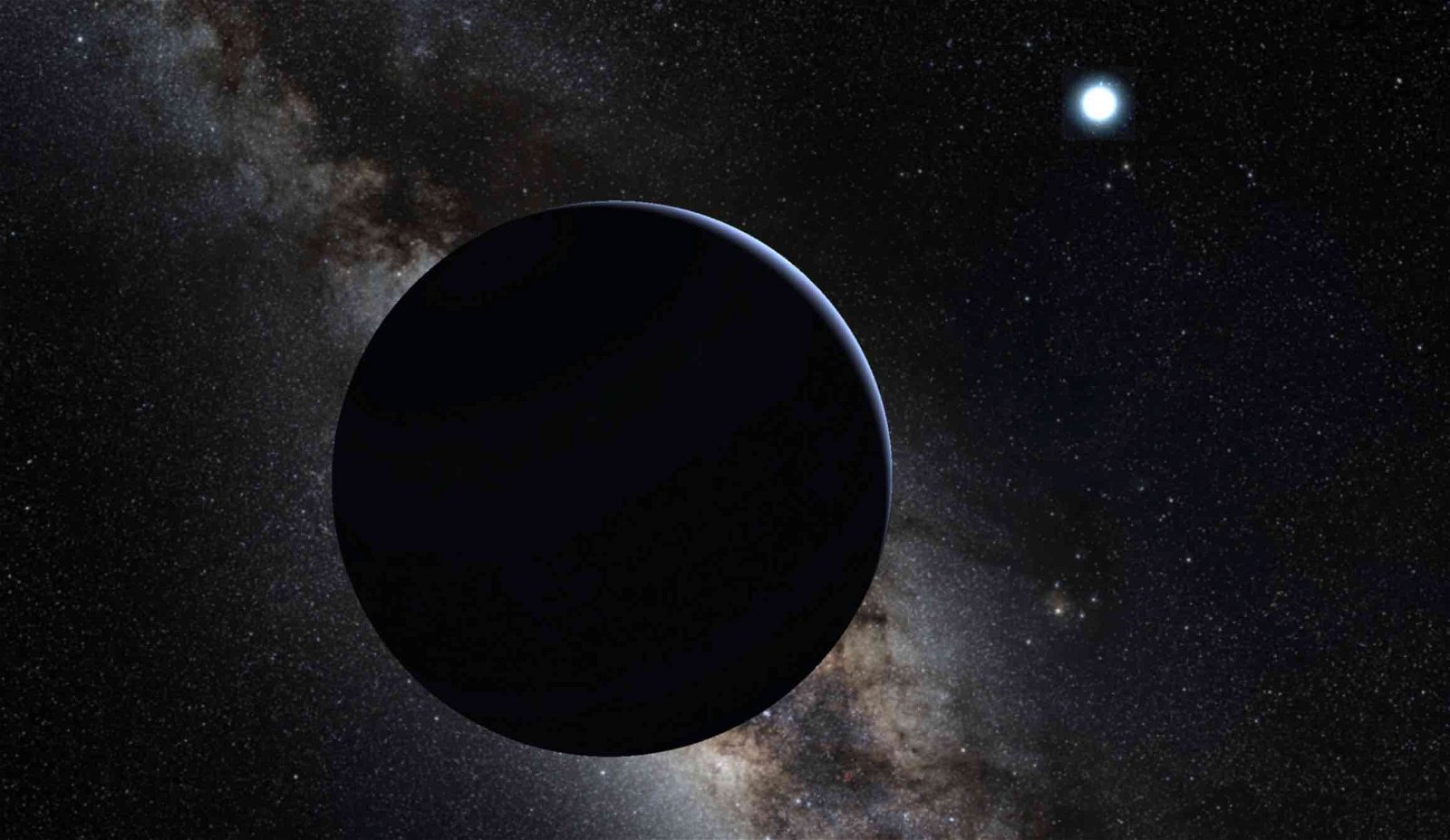
Scientists modeling planetary system formation scenarios say there could be a 40% chance that a hypothetical ‘Planet Nine’, believed by many to lurk at the outer reaches of the Sun’s orbit, could exist.
The study, conducted by researchers at Rice University, also suggests most of these planets don’t end up captured by their host star’s gravity but instead get ejected from the star’s orbit altogether and spend the rest of their lives roaming the galaxy as “rogue planets.”
“Our simulations show that if the early solar system underwent two specific instability phases—the growth of Uranus and Neptune and the later scattering among gas giants—there is up to a 40% chance that a Planet Nine-like object could have been trapped during that time,” said André Izidoro, assistant professor of Earth, environmental and planetary sciences at Rice and the study’s lead author.
Theoretical Planet Nine One of Many “Pinballs in a Cosmic Arcade”
Most stellar planetary system formation models restrict planets’ orbits within the system’s final version to a specific range. However, several unexplained gravitational readings in our solar system have suggested the presence of an undiscovered ninth planet orbiting well outside of this range. Known as ‘Planet Nine’ by advocates for its existence, the theoretical space body belongs to a broader group called wide-orbit planets that are considered rare, in cosmic terms.
In their new study, the Rice University team modeled several distinct scenarios that could result in a planet orbiting well beyond the planetary formation disc. The same research also evaluated several more scenarios in which such planets are ejected from the system completely.
According to a statement announcing the study’s findings, the researchers ran thousands of computer simulations of various multi-planet systems “embedded in realistic star cluster environments.” To increase the accuracy of the models, the team tried several alternative permutations, including systems that feature a mix of gas and ice giants like our solar system and binary systems featuring planets with two suns like Luke Skywalker’s fictional home, Tatooine, in Star Wars.
After comparing the thousands of models, the team found a recurring pattern. When a newly forming star system experienced certain internal instabilities, planets formed within the disc could be pushed to extreme distances. In some cases, such as the theoretical Planet Nine scenario, the gravitational influence of nearby stars in the modeled cluster helps to stabilize the ejected planet in an orbit between 100 and 10,000 Astronomical Units (AUs). This distance is considered relevant since unusual readings from distant Trans-Neptunian Objects (TNOs) seem to place the likely orbit of Planet Nine somewhere between 250 and 1,000 AU.
“When these gravitational kicks happen at just the right moment, a planet’s orbit becomes decoupled from the inner planetary system,” explained study co-author Nathan Kaib, senior scientist and senior education and communication specialist at the Planetary Science Institute. “This creates a wide-orbit planet — one that’s essentially frozen in place after the cluster disperses.”
“Essentially, we’re watching pinballs in a cosmic arcade,” added André Izidoro, assistant professor of Earth, environmental, and planetary sciences at Rice and the study’s lead author. “When giant planets scatter each other through gravitational interactions, some are flung far away from their star. If the timing and surrounding environment are just right, those planets don’t get ejected, but rather they get trapped in extremely wide orbits.”
Ejected Planets More Likely to Go Rogue
While the study supports proponents of the theoretical Planet Nine, it also found that the majority of planets ejected during a stellar system’s formation would escape their host star’s gravitational pull. These difficult-to-detect space bodies end up wandering the cosmos as rogue planets.
“Not every scattered planet is lucky enough to get trapped,” Kaib explained. “Most end up being flung into interstellar space.”

Still, the Rice researcher noted that understanding what percentage of these planets end up in orbit and how many go rogue “gives us a connection between the planets we see on wide orbits and those we find wandering alone in the galaxy.” Known as “trapping efficiency,” the measurement lets the researchers assign a level of probability that each type of simulated planetary system has a Planet Nine of its own.
Surprisingly, the team found that systems like ours had trapping probabilities ranging between 5 and 10%. As previously noted, they also found that when these types of systems experience certain instabilities during their formation, those chances can increase to as much as 40%. The rate of wide-orbit planets was markedly lower in other system types, including lower efficiency systems like those with only ice giants or circumbinary planets.
“We expect roughly one wide-orbit planet for every thousand stars,” Izidoro said. “That may seem small, but across billions of stars in the galaxy, it adds up.”
Christopher Plain is a Science Fiction and Fantasy novelist and Head Science Writer at The Debrief. Follow and connect with him on X, learn about his books at plainfiction.com, or email him directly at christopher@thedebrief.org.