

The brightest fast radio burst (FRB) ever recorded has been observed and described in a new paper in The Astrophysical Journal Letters. Thanks to recent upgrades to the Canadian Hydrogen Intensity Mapping Experiment (CHIME), researchers now have unprecedented precision in tracking these mysterious cosmic signals.
Lasting just milliseconds, fast radio bursts are strong flashes that briefly eclipse the power of any radio source in their galaxy. Although these bursts are detectable for billions of light-years, their sources currently remain disputed amid a range of theories about their possible underlying cause.
CHIME Gets an Upgrade
Researchers credit CHIME’s recent enhancements with enabling this breakthrough detection. Originally built to map hydrogen gas, the large antenna array also proved sensitive to ultrafast and bright radio emissions. Since 2018, CHIME has detected roughly 4,000 FRBs across the sky, but pinpointing their exact locations remained a challenge until now.
The solution came in the form of the CHIME Outriggers, three smaller versions of the array placed across North America. While the main array captures the flashes, the outriggers enable continent-wide triangulation, providing astronomers with precise data on the locations in the sky from which the bursts originate.
“Imagine we are in New York and there’s a firefly in Florida that is bright for a thousandth of a second, which is usually how quick FRBs are,” said Shion Andrew, one of the new study’s co-authors. “Localizing an FRB to a specific part of its host galaxy is analogous to figuring out not just what tree the firefly came from, but which branch it’s sitting on.”
The Brightest Flash of All Time
The newly discovered signal has been informally dubbed RBFLOAT, short for “radio brightest flash of all time.” Located only 130 million light-years away in the constellation Ursa Major, RBFLOAT is both the brightest and among the closest FRBs ever detected. That combination is offering researchers unprecedented insights into the nature of these phenomena.
“Cosmically speaking, this fast radio burst is just in our neighborhood,” says co-author Kiyoshi Masui, associate professor of physics and affiliate of MIT’s Kavli Institute for Astrophysics and Space Research. “This means we get this chance to study a pretty normal FRB in exquisite detail.”
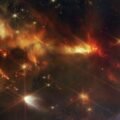
RBFLOAT is the first FRB detected by the newly enhanced CHIME system on March 16, 2025, locating not just the galaxy but the specific region of origination. That point was located near the galaxy’s edge, in a star-forming region, where precise information was required to hunt for clues about what was generating these immense bursts.
“As we’re getting these much more precise looks at FRBs, we’re better able to see the diversity of environments they’re coming from,” said co-author Adam Lanman.
The Source of Fast Radio Bursts
RBFLOAT’s proximity to a star-forming region strengthens the leading theory that FRBs may originate from magnetars, young neutron stars with incredibly strong magnetic fields known to produce powerful flares. However, since the burst came from just outside the star-forming zone, researchers suspect the source may be a somewhat older magnetar.
“These are mostly hints,” Masui says. “But the precise localization of this burst is letting us dive into the details of how old an FRB source could be. If it were right in the middle, it would only be thousands of years old — very young for a star. This one, being on the edge, may have had a little more time to bake.”
Unlike some FRBs, RBFLOAT has not been observed to repeat. A search through CHIME’s archival data turned up no additional signals.
“Right now, we’re in the middle of this story of whether repeating and non-repeating FRBs are different. These observations are putting together bits and pieces of the puzzle,” Masui says.
“There’s evidence to suggest that not all FRB progenitors are the same,” Andrew adds. “We’re on track to localize hundreds of FRBs every year. The hope is that a larger sample of FRBs localized to their host environments can help reveal the full diversity of these populations.”
The paper, “FRB 20250316A: A Brilliant and Nearby One-off Fast Radio Burst Localized to 13 pc Precision,” appeared in The Astrophysical Journal Letters on August 21, 2025.
Ryan Whalen covers science and technology for The Debrief. He holds an MA in History and a Master of Library and Information Science with a certificate in Data Science. He can be contacted at ryan@thedebrief.org, and follow him on Twitter @mdntwvlf.