
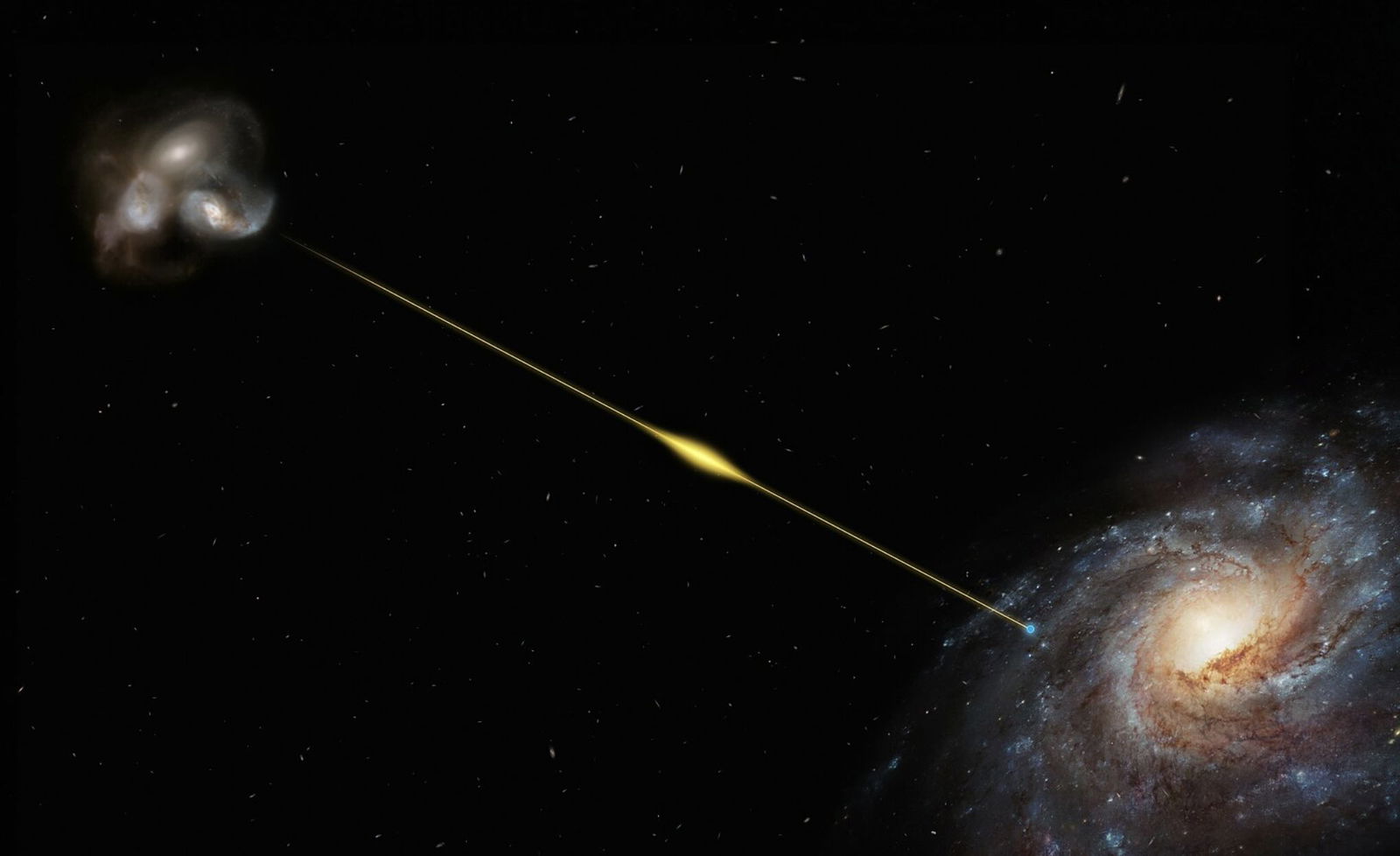
The most distant fast radio burst ever observed, originating from a time when the universe was just three billion years old, has been detected by astronomers.
The landmark discovery of FRB 20240304B, reported in a new paper by an international team of astronomers, was made possible with data obtained by the MeerKAT radio telescope in South Africa, which led astronomers to the eventual detection of a faint, low-mass galaxy using NASA’s James Webb Space Telescope (JWST).
The new findings were reported in a paper by an international team of researchers, which appeared on the preprint server arXiv.org.
The Most Distant Fast Radio Burst
Fast radio bursts (FRBs) are among the most perplexing phenomena in modern astronomy, and their origins remain a topic of intense debate. Proposed explanations span from intense flares produced by distant pulsars to neutron stars, and even the possibility of signals from advanced extraterrestrial civilizations.
These fleeting events generate as much energy in a thousandth of a second as the Sun does in a year, according to NASA. Their brief duration makes them exceptionally difficult to study, and researchers often struggle not only to pinpoint their locations but also to identify the type of cosmic object or processes responsible for their occurrence.
Last year, it was reported an FRB originally detected on June 10, 2022, by the Australian Square Kilometer Array Pathfinder (ASKAP) and later confirmed by the European Southern Observatory’s Very Large Telescope in Chile revealed the presence of FRB 20220610A, which at that time was judged to have been one of the most distant FRBs known.
The newly detected burst originated from a galaxy at a redshift of 2.148, which roughly doubles the previous distance record for a localized FRB, in an observation that provides scientists with an unprecedented view of nearly 80% of cosmic history.
Ancient FRBs in a Miniature Milky Way
FRB 20240304B hails from a small, clumpy, star-forming host galaxy possessing around just 1% of the Milky Way’s stellar mass. The low metallicity and rapid formation of stars occurring in FRB 20240304B’s host galaxy all point to the likelihood of a relatively young, dynamic environment, which researchers associate with the ideal conditions to produce magnetars—highly magnetized neutron stars that also happen to be leading candidates for sources of FRBs.
In their recent study, the authors highlight FRB 20240304B’s high dispersion measure, a signature associated with the amount of material the signal passed through, indicating that it traveled over vast distances of intergalactic space. Along its path, the FRB’s light intersected major cosmic structures, which include the Virgo Cluster.
Based on additional analysis of its polarization and rotation measure, the team discovered something unexpected: FRB 20240304B appears to possess complex magnetic fields along its line of sight.

Overall, FRB 20240304B displays an energy output that ranks it among the highest recorded for one of these mysterious cosmic bursts, offering a potentially significant data point for their study. Specifically, the discovery offers new constraints on what astronomers call the Macquart relation, which links FRB dispersion with their distance, allowing them to be used as a gauge for “weighing” the universe’s distribution of matter.
More fundamentally, the team’s discovery strengthens the case that at least some FRBs occur within a short period after the formation of their progenitor stars, rather than occurring billions of years after the fact.
“Our observations establish FRB activity during the peak of cosmic star formation,” the authors write, “and demonstrate that FRBs can probe galaxy formation during the most active era in cosmic time.”
The paper, “A fast radio burst from the first 3 billion years of the Universe” by Manisha Caleb and colleagues, was posted on the preprint server arXiv.org on August 3, 2025.
Micah Hanks is the Editor-in-Chief and Co-Founder of The Debrief. A longtime reporter on science, defense, and technology with a focus on space and astronomy, he can be reached at micah@thedebrief.org. Follow him on X @MicahHanks, and at micahhanks.com.