

An unusual “inside-out” planetary system around the star LHS 1903 is challenging astronomers’ understanding of planet formation after being observed by the European Space Agency’s CHaracterising ExOPlanet Satellite (CHEOPS).
An international team of astronomers led by the University of Warwick discovered a planetary system arranged in nearly the opposite order of our own and most others. Their findings, published in Science, provide new insight into a chain of planets markedly different from our solar system.
Planetary Systems in the Milky Way
In our solar system, rocky planets—from Mercury to Mars—orbit closest to the Sun, followed by gas giants from Jupiter to Neptune. This pattern is not unique; similar arrangements are commonly observed throughout the Milky Way.
Observed with CHEOPS, LHS 1903 is a cool red dwarf star. At first glance, its planetary system appears to follow expectations: a tightly orbiting rocky planet is followed by two gas-rich planets. However, the pattern breaks down with the presence of another rocky planet at the outer edge of the system.
“This is the first time that we’ve found and precisely measured the properties of four planets around such a cool red dwarf star in this order,” lead author Dr Thomas Wilson, Assistant Professor in the Department of Physics, University of Warwick told The Debrief. “Previous work has found similar results but with fewer planets that means we cannot be as confident about their conclusions.”
Explaining Unusual Order
Astronomers do not believe the typical ordering of planets is accidental. One explanation is that intense stellar radiation strips atmospheres from planets close to the star, leaving only more distant worlds able to accumulate thick gaseous envelopes. The team suggests the outer rocky planet may represent a world that either never acquired a dense atmosphere or lost it early in its history.
The researchers tested several possible explanations and ruled out two. One idea was that the planet had swapped places with one of the gas planets.
“We ruled this out as to conform to standard planet formation theory, the outer planet would have to switch places with the two gas planets,” Dr. Wilson explained. “This would have de-stabilised the orbits of the planets, leading to removal from the planetary system, impact into other planets, or the host star. We ran dynamical simulations and found that the current orbits are stable, meaning that this planet’s orbit switching can be rejected.”
Another possibility was that a large collision stripped the planet’s atmosphere.
“Similarly for the orbit switching, a single giant impact that would have had enough energy to remove the predicted atmosphere of the outer planet would have both destabilised the orbit and potentially destroyed the planet itself,” Dr. Wilson added. “We also ruled out many smaller impacts as such a storm of objects passing through the planetary system would have very likely also impacted the inner planets, removing their atmospheres.”
An Inside Out Planetary System
“By the time this final outer planet formed, the system may have already run out of gas, which is considered vital for planet formation,” said Dr. Wilson. “Yet here is a small, rocky world, defying expectations. It seems that we have found [the] first evidence for a planet that formed in a gas-depleted environment.”
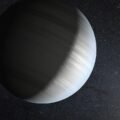
The team believes a theoretical model known as inside-out planet formation best explains the observations. Rather than forming simultaneously, the planets may have formed sequentially. As earlier planets consumed more of the gas and dust in the protoplanetary disk, the final planet formed in an environment largely depleted of material.
“Inside-out planet formation was developed to explain the radii of planetary systems found by the Kepler space telescope,” Dr. Wilson explained. “However, this is the first time it has been coupled with proto-planetary disk physics to interpret the densities and compositions of exoplanets. Future missions, such as ESA’s PLATO, will discover more planetary systems that will allow us to test inside-out formation even more.”
The paper, “Gas-depleted Planet Formation Occurred in the Four-planet System Around the Red dwarf LHS 1903,” appeared in Science on February 6, 2026.
Ryan Whalen covers science and technology for The Debrief. He holds an MA in History and a Master of Library and Information Science with a certificate in Data Science. He can be contacted at ryan@thedebrief.org, and follow him on Twitter @mdntwvlf.