

New data collected by NASA’s James Webb Space Telescope (JWST) is helping researchers map the cosmic web in the greatest detail ever achieved, providing new insights into the network of galaxies as improved resolution reveals hidden features.
An international team of researchers led by the University of California, Riverside, revealed their newest findings based on Webb telescope data in a recent study published in the Astrophysical Journal, tracing the cosmic web back to the first billion years of our universe.
The cosmic web consists of filaments and sheets of dark matter that connect the universe’s galaxies through the voids of space, forming an intricate architecture and driving galaxy evolution.
James Webb Space Telescope
JWST has been a tremendous boon to scientists since its 2021 launch, revealing faint, distant galaxies in the infrared spectrum that would previously have been unresolvable. Researchers have used it for everything from collecting more precise data on the Hubble tension to discovering what astronomers call “Little Red Dots,” a series of unexpected, distant, bright red objects.
The speed of light is measured at 5.88 trillion miles per year, which defines the light-year, the unit astronomers use to measure distances across the cosmos. One billion light-years is considered our local neighborhood, but JWST observations stretch far beyond that, due to its incredible clarity. This allows scientists to resolve light from distant corners of the universe, which is now only reaching us billions of years later, providing a window into the ancient universe.
COSMOS-Web
COSMOS-Web, the largest JWST study ever conducted, provided 13.7 billion years of cosmic data for researchers to use in their mapping project. Designed expressly for mapping the cosmic web, COSMOS-web explored an area of sky the size of three full moons.
“JWST has completely changed our view of the universe, and COSMOS-Web was designed from the start to give us the wide, deep view we need to see the cosmic web,” said lead author Hossein Hatamnia, a graduate student at UCR and Carnegie Observatories. “For the first time, we can study the evolution of galaxies in cluster and filamentary structures across cosmic time, all the way from when the universe was a billion years old up to the nearby universe.”
With its incredibly high level of clarity, comparing the new JWST map to earlier Hubble Space Telescope maps of the same region reveals new structures that previous efforts failed to resolve.
“The jump in depth and resolution is truly significant, and we can now see the cosmic web at a time when the universe was only a few hundred million years old, an era that was essentially out of reach before JWST,” said co-author Bahram Mobasher. “What used to look like a single structure now resolves into many, and details that were smoothed away before are now clearly visible.”
JWST Peers Back in Time
“The telescope detects many more faint galaxies in the same patch of sky, and the distances to those galaxies are measured far more precisely,” Mobasher added. “Each galaxy can therefore be placed into the correct slice of cosmic time, sharpening the map’s resolution.”
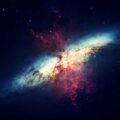
This means that the new map is not only filling in scientific knowledge about the broader structure of the universe, but also how the structure was built over time. In this data, the team discovered that the cosmic web had a major effect on galaxy growth over time, while also suppressing star formation in older galaxies. The detailed maps of the comic web developed under COSMOS-web will be released to the public.
“The pipeline used to build the map, the catalog of 164,000 galaxies and their cosmic density,” Mobasher concluded, “and a video showing the cosmic web evolving across billions of years, has been released to the public.”
The paper, “Large-Scale Structure in COSMOS-Web: Tracing Galaxy Evolution in the Cosmic Web up to z ∼ 7 with the Largest JWST Survey,” appeared in the Astrophysical Journal on May 6, 2026.
Ryan Whalen covers science and technology for The Debrief. He holds an MA in History and a Master of Library and Information Science with a certificate in Data Science. He can be contacted at ryan@thedebrief.org, and follow him on Twitter @mdntwvlf.