

A University of Colorado at Boulder astrophysicist has proposed a new method for detecting and tracking gravitational waves, which are so powerful that they warp the fabric of space and time.
Improving the detection of gravitational waves as they ripple through the universe could help scientists explore some of the universe’s most enduring mysteries, including unraveling the intersection of electromagnetism and the force of gravity.
“There is a lot we can learn from getting these precise measurements of gravitational waves,” explained Jeremy Darling, professor in the UC Boulder Department of Astrophysical and Planetary Sciences. “Different flavors of gravity could lead to lots of different kinds of gravitational waves.”
Gravitational Waves That Warp the Fabric of Space and Time
First proposed by famed theoretical physicist Albert Einstein, gravitational waves weren’t detected until scientists using the Laser Interferometer Gravitational Wave Observatory (LIGO) detected their telltale signature in 2015. Since that first detection, several novel applications of LIGO and planned future detectors have been proposed.
In 2022, the international think tank Applied Physics proposed using gravitational waves to spot the signature of spacecraft using a Star Trek-style “warp drive.” In 2025, the same organization announced a project led by Harvard Astrophysicist Dr. Avi Loeb that would use the detection of gravitational waves for planetary defense. Dr. Loeb has proposed that alien civilizations could be using gravitational waves to communicate. SETI has suggested that gravitational waves could help detect advanced extraterrestrial civilizations.
Still, detecting gravitational waves as they warp the fabric of space and time is extremely difficult even for the most advanced modern instruments. According to Darling, there may be a better way.
Light from quasars to detect Gravitational Waves
In his study, Darling points out how the history of the cosmos was filled with supermassive black holes that spin around each other in a sort of death dance. When these massive cosmic structures finally collide, Darling believes they cause ripples throughout the universe that warp the fabric of space and time.
“This background noise washes over our planet all the time, although you’d never know it,” explained a UC Boulder statement announcing the professor’s findings.
Unlike theoretical gravitational waves created by a spacecraft surrounded by a warp bubble that would move rapidly like ripples in a pond, Darling’s new approach looks for slow-moving gravitational waves. According to the professor, this category of waves generated by black hole collisions could take years or even decades to pass over Earth.
To search for this class of gravitational wave, Darling enlisted the help of a completely different cosmological phenomenon, the quasar. Unusually bright black holes at the center of galaxies, quasars, should reveal the presence of slow-moving gravitational waves as they pass between them and Earth. According to Darling, that’s because the light coming from the quasar is continuously warped by gravitational waves as they travel through space.
“If you lived for millions of years, and you could actually observe these incredibly tiny motions, you’d see these quasars wiggling back and forth,” Darling explained.
Detecting this effect, which would be up and down, side to side, and front to back, would represent a whole new way to spot gravitational waves as they warp the fabric of space and time.
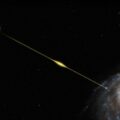
“Gravitational waves operate in three dimensions,” Darling said. “They stretch and squeeze spacetime along our line of sight, but they also cause objects to appear to move back and forth in the sky.”
Detection Will Likely Require More Observations
After analyzing the data on over 1 million quasars captured by the European Space Agency’s Gaia Observatory, Darling has not measured these changes in the light from quasars caused by gravitational waves bombarding them and warping the fabric of space and time.
Fortunately, the GAIA team plans to make another five and a half years ‘ worth of data on quasars in 2026. Darling says adding that “treasure trove” of data to the previous batch, which was collected over three years, could prove the validity of his new method.
“If we can see millions of quasars, then maybe we can find these signals buried in that very large dataset,” he said.
Christopher Plain is a Science Fiction and Fantasy novelist and Head Science Writer at The Debrief. Follow and connect with him on X, learn about his books at plainfiction.com, or email him directly at christopher@thedebrief.org.