
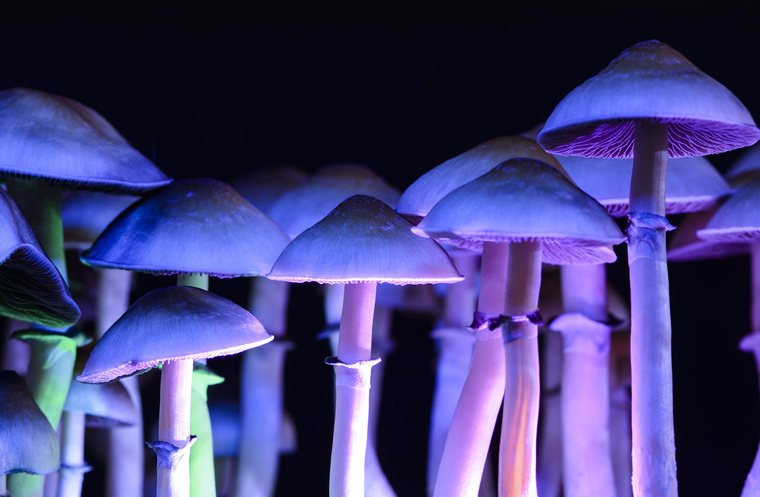
A team of Canadian researchers studying the possible anxiety-reducing effects of psilocybin, the psychoactive ingredient in so-called magic mushrooms, has revealed that the chemical compound makes an innately aggressive species of fish less aggressive and lazier compared to undrugged fish without reducing its overall social activities.
The research team behind the discovery said future research will be needed to confirm their findings, explore how the active ingredient in magic mushrooms alters neural signaling, identify the active serotonin pathways involved in these behavioral changes, and determine why certain behaviors are altered by exposure while others appear to remain unaffected.
Testing Magic Mushrooms to Evaluate Changes in Fish Aggressiveness
According to a statement announcing the research, over 200 mushroom species contain the active compound psilocybin. The majority of these species belong to the genus Psilocybe, including the well-known magic mushrooms popularized in the counterculture era for their psychoactive properties.
When this substance is ingested by mammals, it can bind to serotonin receptors that are involved in the regulation of behavior and emotions. Notably, these chemically induced changes can affect aggression, appetite, and overall mood. However, the researchers note, the effect of psilocybin on animals “remains largely undescribed.”
Since conducting experiments on human subjects poses significant challenges and limitations, the researchers examined whether these behavioral and mood changes also occur in fish. This led the team to choose the amphibious mangrove rivulus (Kryptolebias marmoratus), which they described as “innately aggressive,” especially when paired with another fish.

“Their aggressive behaviors are straightforward, and subtle changes can easily be detected,” the team explained. “Therefore, this model ensures all observed effects are caused by psilocybin treatment rather than genetic differences between fish.”
‘Dosed’ Fish Appear to Selectively Reduce Energetically Costly Behaviors
After selecting three genetically distinct laboratory-bred lines of mangrove rivulus, they exposed one to psilocybin, whereas the second line served as “stimulus fish,” intended to trigger behaviors in the ‘drugged’ fish. The team said that the third selected line was used to “quantify whole-body concentrations and absorption of psilocybin” rather than for behavioral evaluation.
During the experiment’s first phase, fish from the first group were placed in a tank already containing the second line of ‘stimulus’ fish. Critically, the two groups were separated by an opaque cover placed over a fiberglass mesh barrier. The researchers said this arrangement allowed the fish to see and smell each other but prevented direct contact.
During this five-minute adjustment period, the team measured behavior to establish a baseline. When the five minutes expired, the barrier was removed, and the interaction between the two fish groups was closely monitored for signs of behavioral or mood changes.
Twenty-four hours after the first phase was completed, the team placed the fish from the first ‘focal’ group in a water tank containing dissolved psilocybin. The fish remained in the psilocybin-enriched tank for 20 minutes to ensure sufficient saturation, then were returned to the tank with the stimulus fish from the previous day’s experiments. Like before, the fish remained separated for five minutes by the opaque mesh barrier before it was removed.
Once again, the team monitored interactions between the two groups to determine whether the ‘drugged’ fish exhibited any behavioral changes. They also looked for potential clues to the fish’s mood. This included measuring the time the fish spent moving and their aggression levels, such as the frequency of swimming ‘bursts’ toward other fish.
According to the researchers, when they compared the fish in the first group’s activities before and after exposure to psilocybin, several changes were observed. Among the most prevalent was an overall reduction in activity after exposure to magic mushrooms’ key ingredient.
“Dosed fish (spent) less time moving than control fish when paired with a conspecific,” they explained, “and performed fewer swimming bursts compared to specimens that hadn’t received psilocybin treatment.”
The study’s senior author, Dr. Suzie Currie, a biologist at The University of British Columbia, defined swimming bursts as “high‑energy attack behaviors that represent an escalation of aggression towards the stimulus fish” but stop short of making physical contact.
“Other types of aggressive behaviors, like head‑on displays, are more about communication and social assessment and require very little energy,” Dr. Currie explained.
The study’s first author, Dayna Forsyth, a research associate and former MSc student at Acadia University in Nova Scotia, said the calming effect of psilocybin observed during their experiments appeared to “selectively reduce energetically costly, escalated behaviors” while other social display behaviors that require less energy remained largely unchanged.
“This suggests that this compound can selectively dampen escalated social conflict rather than shutting down behavior altogether,” Forsyth added.
Reducing Escalated Aggression Without Suppressing Social Interaction
When discussing the implications of their findings, Forsyth said their findings show that an acute, low dose of the active ingredient from magic mushrooms “significantly reduces activity and aggressive attack behavior during social interactions in adult mangrove rivulus fish.” The research added that the observed change was particularly significant, as the selected fish is a “naturally highly aggressive” species.

“These findings provide the first evidence that psilocybin can selectively reduce escalated aggression in a vertebrate model without suppressing social interaction,” added Currie.
When discussing the potential long-term impacts of their findings, the team said their work can provide “robust results” that can, in theory, ultimately be translated to humans. They also noted that their work could “help inform therapeutic research” by helping scientists further clarify which aspects of social behavior are most sensitive to psilocybin exposure.
Although the results were statistically significant, the researchers caution that their study faced several limitations that should be explored by future efforts. For example, they did not test any potential clinical treatments. They also noted that their findings “cannot be directly extrapolated” to humans exposed to psilocybin.
“The study also focused on single doses and short periods of exposure, and didn’t examine long-term effects, repeated dosing, or adaptation over time,” they added.
The team noted that future studies will be needed to determine whether the social changes observed after magic mushroom ingestion are sustained or transitory.
“Future studies can build on this work to explore how psilocybin alters neural signaling, which serotonin pathways are involved, and why some aspects of social behavior are affected while others are not,” Currie said, adding that “these are questions that are difficult or impossible to answer directly in humans.”
The study “The magic of mushrooms: Psilocybin influences behaviour in the mangrove rivulus fish, Kryptolebias marmoratus” was published in Frontiers in Behavioral Science.
Christopher Plain is a Science Fiction and Fantasy novelist and Head Science Writer at The Debrief. Follow and connect with him on X, learn about his books at plainfiction.com, or email him directly at christopher@thedebrief.org.