
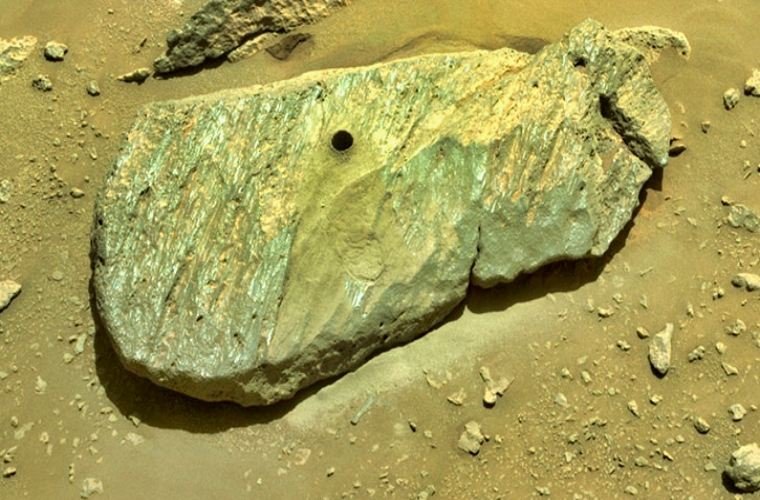
After years of delays and debate, the United States Congress has passed a NASA budget that omits any plan to retrieve several rock and soil samples collected and stored by the Perseverance Rover, including Martian rocks that may contain signs of past or present extraterrestrial life on the Red Planet.
According to the new compromise spending bill for the current fiscal year, it appears Congress has given in to the White House’s demands that resources needed to complete the planned Mars Sample Return (MSR) program be explicitly excluded from any approved budget. While the bill still awaits a final vote in Congress and the President’s signature, NASA officials are sending signals that the MSR program is effectively dead.
“The agreement does not support the existing Mars Sample Return program,” the bill states.
Victoria Hamilton, a planetary scientist at the Southwest Research Institute (SwRI) and chair of NASA’s Mars Exploration Program Analysis Group, described the death of MSR as “deeply disappointing” while also questioning the veracity of the current administration’s stated goals.
“When we’ve got memos coming out saying we want to be the dominant power in space, I wonder how we leave something this ambitious behind,” Hamilton said.
Escalating Cost of Retrieving Martian Rocks has Haunted the MSR Program
Before NASA launched Perseverance in July 2020, mission planners had struggled with the concept of retrieving the samples the rover was tasked with collecting through its mission. Since then, the interplanetary explorer has collected dozens of samples and stored them for the planned future return.

During that time, the cost for MSR has continued to rise, with 2024 estimates reaching $11 billion. Regardless of the potential scientific value, the extraordinarily large share of NASA’s science budget that the single mission was projected to consume left planetary scientists working on other stalled or underfunded projects wondering whether the MSR was worth the broader scientific cost.
Repeated threats from Congress to scrap the ambitious yet costly program altogether resulted in a new, stripped-down plan released in January 2025 that came closer to the original $7 billion estimate. Now, it appears even that plan was still too rich for the current administration’s taste, resulting in its explicit exclusion from the new bill.
Funding Could Aid Other Missions and Keep Hopes of MSR Alive
As advocates of the MSR program try to regroup and seek other alternatives to bring the Martian rocks back to Earth to study, NASA’s proposed $7.25 billion science budget offers some hope that a future mission may not be completely off the table.
For example, the bill, which cuts roughly 1% from the 2025 budget, allocates $110 million for a “Mars Future Missions” program to continue developing the key technologies needed for any future sample-return mission. These include further development of landing systems that can survive the thin atmosphere during descent, which has proven challenging and costly for previous missions.

Assuming the bill is signed into law, other missions that have waited patiently for MSR to run its course may see new signs of life. For example, recent discoveries on the moons of Jupiter and Saturn and in the atmosphere of Venus have led to plans for missions to further explore those tantalizing findings. These include plans to explore potential subsurface oceans on Enceladus and Europa for extraterrestrial life.
Is the Search for Extraterrestrial Life on Mars Dead?
Although the newly proposed NASA science budget adds hope to the search for life on other moons and planets, proponents of MSR note the tantalizing cache of samples already collected by the rover since its 2021 arrival.

In 2024, mission operators spotted a surface feature containing mineral deposits called “leopard spots” in a dry riverbed that leads to Jezero crater. NASA scientists note that on Earth, these types of leopard spots are often left by microbial organisms interacting with the rock, making the Chevaya Falls sample arguably the best candidate for containing signs of past life on Mars.
Bethany Ehlmann, a planetary scientist at the University of Colorado Boulder, said scientists eagerly await the opportunity to examine these samples in Earth labs equipped to determine if they do hold signs of extraterrestrial life. Elhman also pointed to the potential for other scientific discoveries that the dozens of samples gathered by Perseverance may hold.
“A rock with a potential biosignature is awaiting return now, and other rocks hold breakthrough discoveries,” the UC Boulder scientist explained.
Unless Congress has an unexpected last-minute change of heart, the new budget has left mission planners wondering about the fate of the samples, as the rover has nearly finished filling its collection tubes.
“We’d really like to hear from NASA sooner than later that they will work with the community on a plan to get these samples,” Hamilton said.
Christopher Plain is a Science Fiction and Fantasy novelist and Head Science Writer at The Debrief. Follow and connect with him on X, learn about his books at plainfiction.com, or email him directly at christopher@thedebrief.org.