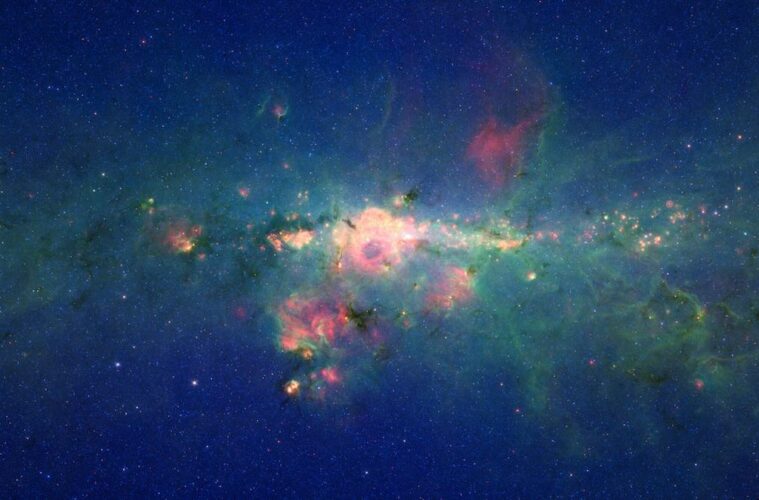
Scientists have developed a new program, "Effort.jl," that utilizes AI and physics to simulate the universe at a faster rate than ever, enabling scientists to map cosmic structure in minutes.
A trio of newly discovered exoplanets is defying the expectation that binary systems are hostile to planet formation, according to an international team of researchers.
Astronomers have discovered the longest gamma-ray burst ever recorded, revealing that a black hole literally consumed a star from the inside out over the course of seven hours.
Highly anticipated new images of the interstellar comet 3I/ATLAS as it made its nearest pass to the planet Mars last week have been released by the European Space Agency.
A recent study suggests that Mars displays clear geological signs indicating that ancient rivers once emptied into a massive body of water in its northern hemisphere.
Wisconsin's historic Yerkes Observatory reveals a place where Edwin Hubble, Carl Sagan, and many pioneering women of astronomy once explored the cosmos.
Astronomers have obtained new images of the mysterious interstellar object 3I/ATLAS that reveal a new feature: the fastest comet ever observed has now grown a tail.
A massive space rock that once made its way onto a space agency's warning list for potentially dangerous objects is scheduled to pass by the Earth this Thursday, September 18, 2025.
According to China's space agency, the government is preparing to test a direct method of planetary defense by sending a spacecraft to collide with an asteroid.