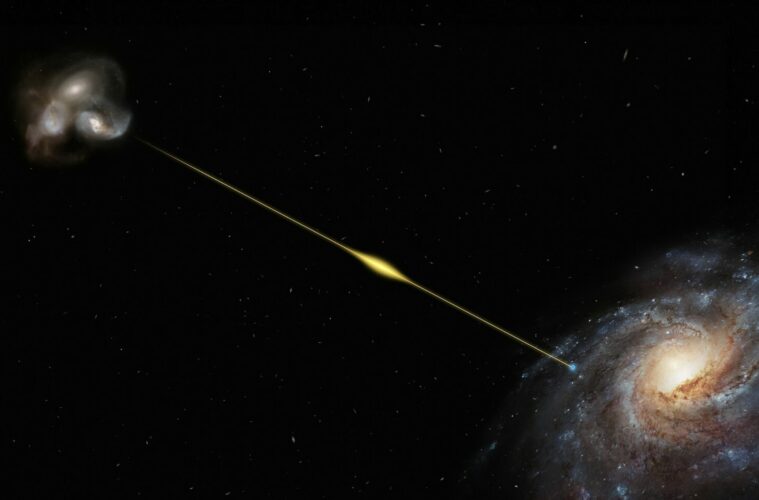
A NASA veteran’s multi-year survey of over 1,300 Sun-like stars has discovered several mysterious fast pulses of light that defy traditional cosmological explanations.
For the first time, astronomers have used NASA's James Webb Space Telescope to peer through the thick haze of a sub-Neptune planet’s atmosphere, offering new clues about one of the universe’s most mysterious and common types of worlds.
Exotic properties suggested by recent DESI collaboration data are more likely to apply to dark energy than dark matter, argues Harvard astronomer Avi Loeb.
The largest cosmic structure ever observed by astronomers is revealing its biggest cosmic secrets yet, with a little help from powerful gamma-ray bursts.
NASA’s Lucy spacecraft is set to fly by the asteroid Donaldjohanson on April 20 in a key rehearsal for its primary mission to study Jupiter’s Trojan asteroids.
The James Webb Space Telescope's MIRI instrument has captured the final moments of a planet's existence, unexpectedly revealing that the object descended into its host star rather than being engulfed by it as it grew.