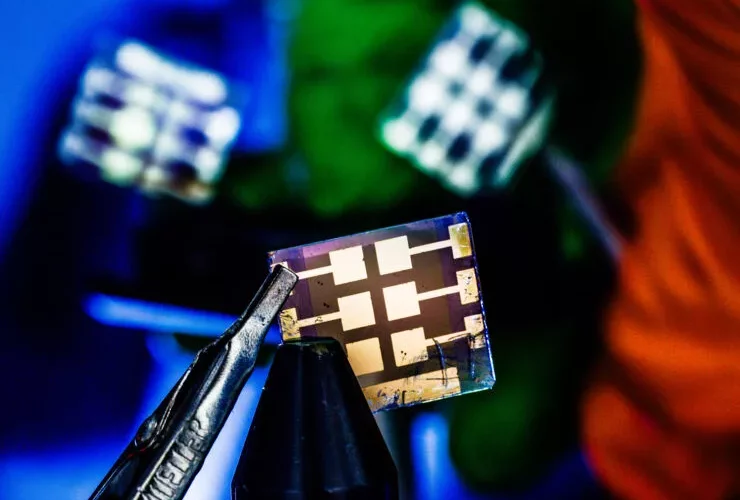

Harvard researchers say they have succeeded in developing a method of controlling points of darkness known as optical singularities with the help of metasurfaces.
Google says its Sycamore quantum processor can now make instant calculations that would require the fastest conventional computers currently in existence almost half a century to complete.
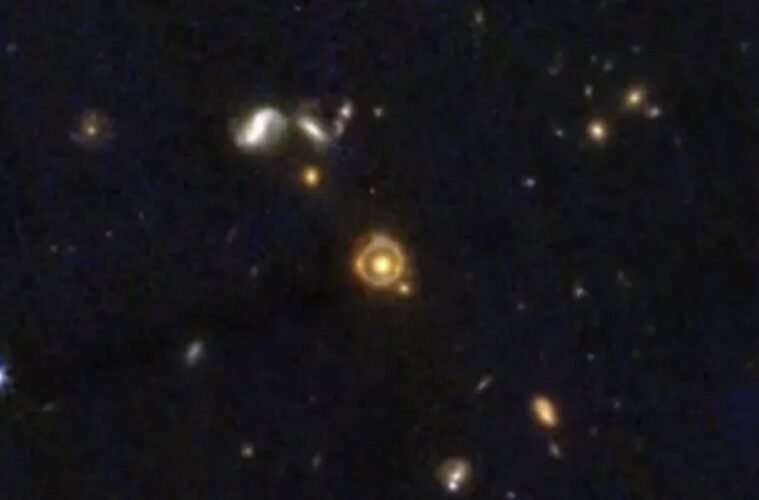
New research using the most advanced tools available to astronomers has proven that time moved five times slower a billion years after the Big Bang than it does in the present, proving Albert Einstein was right again.
An international team of researchers says they have discovered a new variety of quantum vortexes within superconductors, pointing to a previously unknown circulatory phenomenon.
A team of Professors in Germany has established a 4-year, multi-million euro program to study ancient magic and magical texts called “Magic between Entanglement, Interaction, and Analogy,” or MagEIA.
Here are five ways detection of the gravitational wave background (GWB) by the North American Nanohertz Observatory for Gravitational Waves (NANOGrav) revolutionizes our understanding of the universe.
Researchers have developed a seemingly magical material inspired by the skin of squids that can block EM emissions, microwaves and IR heat, and also switch between transparent and opaque states simply by being stretched or contracted.
A new carbon compound has been detected in space for the first time using NASA’s James Webb Space Telescope, according to an international team of researchers.

New research looking into the effects of time dilation may help researchers unlock the mysterious nature of Dark Matter and the accelerated expansion of the universe by supporting or disproving the theories of Albert Einstein
A Spanish researcher who has previously discovered water, carbon dioxide and other key life-supporting chemicals in an interstellar region of space where planets and stars are born says she has now found the life-supporting amino acid tryptophan in the same place.
New data from the James Webb Space Telescope (JWST) suggests an exoplanet with once-promising potential for life shows no signs of having a thick atmosphere.
A team of Canadian researchers says that the lack of clumpiness in the structure of the universe could help to shed new light on the composition of dark matter.
The Galileo Project continues its recovery of material from the ocean floor during its expedition to recover an interstellar object off the coast of Papua New Guinea.
A new bill introduced by the House Transportation and Infrastructure Committee includes language that will task the Federal Aviation Administration (FAA) with tracking objects deemed to be a risk resulting from airborne debris.

A new study examining the orbital eccentricity of exoplanets has determined that as many as 1 in 3 planets orbiting the billions of M-dwarf stars in the Miky Way galaxy may be habitable.

IN an effort to help U.S. forces defend against the rapidly increasing threat from low-cost enemy drones, Raytheon Technologies has delivered the first fully portable, combat-ready drone to the Air Force.
Engineers at MIT say they have developed a new motor that could be used to electrify large aircraft, significantly reducing their carbon footprint with the help of innovative new electric propulsion technology.
A formidable next-generation inertial sensor will soon be deployed by the United States Navy, which it says will offer vast improvements to its present maritime navigational capabilities.
Ukrainian Defense officials say that the Storm Shadow Long Range missiles provided by Great Britain have been wreaking havoc on Russian forces with 100% accuracy.
On Wednesday, members of a NASA independent study team held a public briefing on its current efforts to categorize and evaluate data related to unidentified anomalous phenomena (UAP).
A collaboration between the Air Force and MIT called MagNav completed the first successful flight of a DOD aircraft using AI-enhanced magnetic navigation as a substitute for GPS.
A new warning about the potential dangers artificial intelligence (AI) may represent for humankind in the years ahead was voiced on Tuesday by leading scientists and tech industry experts.
Researchers funded by the National Institute of Health are beginning human clinical trials on a drug that can help people survive a dirty bomb attack, an accidental ingestion of nuclear material, or even a nuclear war.
A series of new scientific papers detailing methods of detection and investigation into unidentified aerial phenomena (UAP) has been published by a team of Harvard researchers.
With a highly classified solicitation sent out to industry partners, the United States Air Force is looking to award a contract in 2024 to replace the F-22 with a Next Generation Air Dominance (NGAD) fighter.
DARPA has announced a new program aimed at developing unique electrode materials that can be used to produce a magnetohydrodynamic (MHD) drive for the U.S. military.