
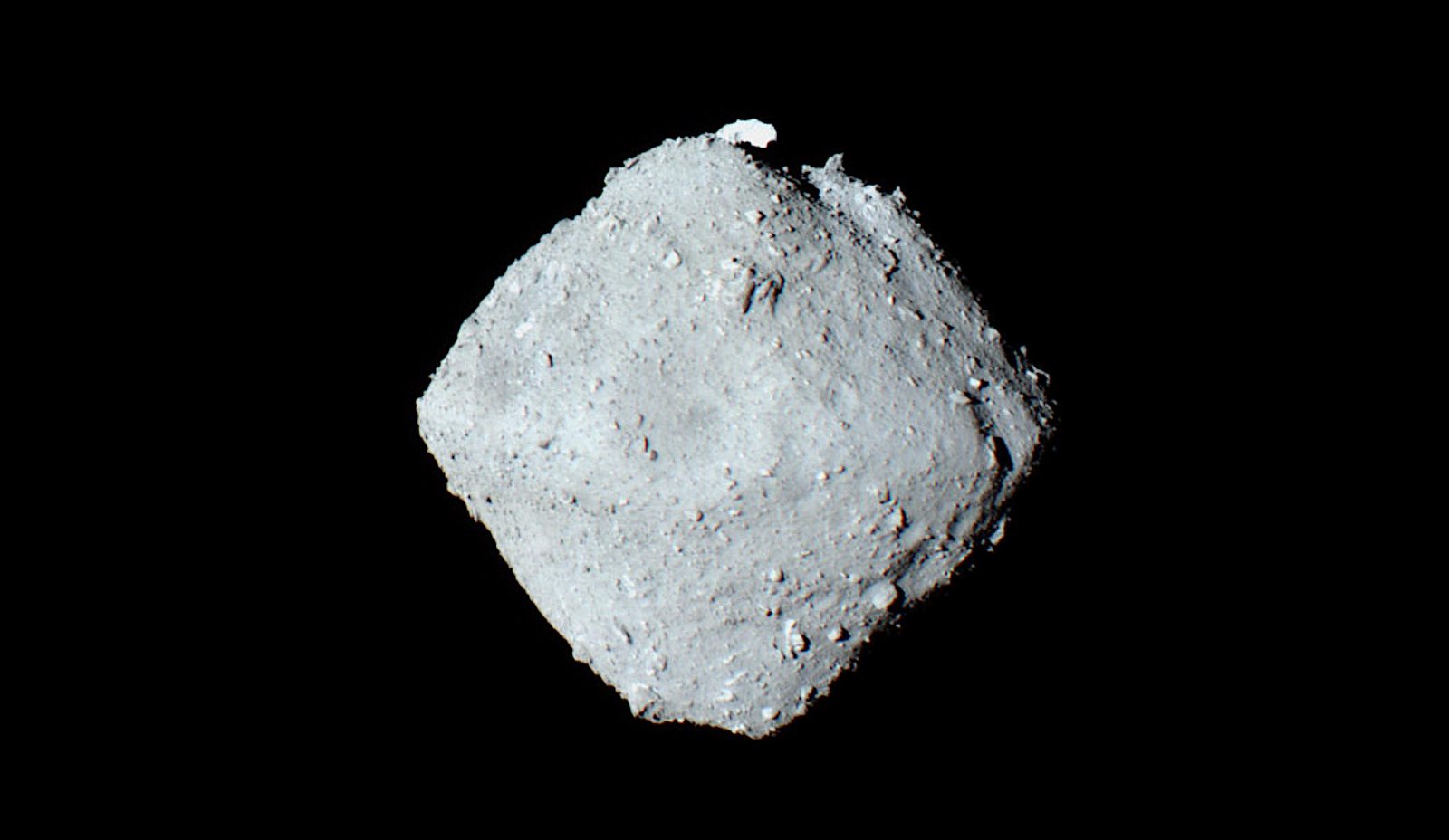
The complete set of the fundamental building blocks of life—all five nucleobases found in DNA and RNA—has been discovered in return samples from the asteroid 162173 Ryugu, according to researchers at Hokkaido University in Japan.
This marks the second time researchers have identified these chemicals on a carbonaceous asteroid, following findings from samples returned from 101955 Bennu by OSIRIS‑REx, reinforcing the idea that key components of life were commonly produced in the early solar system.
The researchers revealed their findings, based on a sample collected during the JAXA mission to Ryugu, in a recent paper published in Nature Astronomy.
The Asteroid Ryugu
Ryugu is a near-Earth object roughly 3,000 feet in diameter, named after a mythical underwater palace in Japanese folklore. Astronomers first discovered Ryugu in 1999. Fifteen years later, in 2014, the Hayabusa2 spacecraft launched from Earth to rendezvous with the asteroid in 2018.
In December 2020, the mission successfully returned samples to Earth—echoing the mysterious box carried by the folktale hero Urashima Tarō, for whom the asteroid’s namesake palace is remembered.

Initially, mission planners intended to collect three samples from Ryugu. However, technical concerns led the team to limit the collection to two to avoid unnecessary risk to the spacecraft. In total, the mission returned about 5.4 grams of material from the asteroid.
The Arrival of Life
A hypothesis known as Panspermia proposes that the building blocks of life may be distributed throughout the universe by asteroids, meteors, comets, and potentially even artificial spacecraft. Much like invasive species spreading from one ecosystem to another on Earth, these primitive chemical ingredients may have traveled across the cosmos before reaching young planets.
The idea has faced criticism, including arguments that it does not explain how life originally formed and instead merely shifts the question elsewhere. Nevertheless, the new research adds further evidence that at least the molecular ingredients for life may have been delivered to Earth by asteroids—even if life itself was not.
These findings add to a growing body of evidence that began with the Bennu samples. Research published last year also reported the presence of all five nucleobases in material returned from that asteroid. In addition, two meteorites that landed on Earth have previously been shown to contain nucleobases. Taken together, the findings suggest these molecules may be widespread throughout the solar system.
Investigating the Material
To preserve the integrity of the Ryugu samples, researchers took extensive precautions to prevent contamination from organic material on Earth. They used water and hydrochloric acid to extract organic compounds from the sample before purifying the molecules for analysis.
After purification, the team identified the nucleobases that serve as key components of DNA and RNA. When combined with phosphates and sugars, these molecules form the molecular blueprints that encode genetic information in living organisms.
The nucleobases fall into two categories: purines—adenine and guanine—and pyrimidines—cytosine, thymine, and uracil. The Ryugu samples contained roughly similar quantities of both categories, unlike the skewed ratios previously observed in Bennu samples and known meteorites.
Researchers suggest that variations in ammonia levels within different asteroids may explain these chemical differences. If confirmed, this could indicate that previously unrecognized chemical pathways helped produce nucleobases in the early solar system.
The research team says further investigation into these potential pathways will help scientists better understand how chemical environments across the solar system may have produced the essential building blocks of life.
The paper, “A Complete Set of Canonical Nucleobases in the Carbonaceous Asteroid (162173) Ryugu” appeared in Nature Astronomy on March 16, 2026.
Ryan Whalen covers science and technology for The Debrief. He holds an MA in History and a Master of Library and Information Science with a certificate in Data Science. He can be contacted at ryan@thedebrief.org, and follow him on Twitter @mdntwvlf.