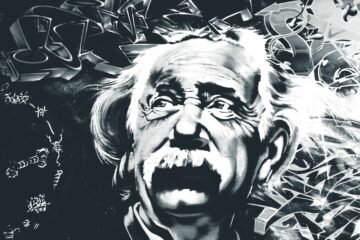
Einstein's equations have withstood every experimental test for more than a century; however, according to one philosopher, they have not withstood careful scrutiny of the language used to describe them.
This week in news from The Debrief, new research resolving a century-old debate surrounding the double-slit experiment, communication with light, and more are featured.
New research suggests numerical relativity, a computational approach to the Einstein's equations, could resolve some of cosmology's greatest questions.
New research sets the most stringent limit yet on the mass of the graviton, suggesting it may indeed be massless as predicted by Einstein's theory of gravity.
New mathematics could provide researchers with a framework for a "unified theory" that will allow new methods of resolving several of the universe’s mysteries.
Physicists are one step closer to the measurement of gravity at the quantum level, findings that may broaden our understanding of some of the most mysterious forces at work in our universe.
A group of theoretical physicists says that a superluminal world possessing three time dimensions and one space dimension could change our concept of time.
In this week's Intelligence Brief, we look at a mysterious object traveling at 8% of the speed of light, the fastest object ever observed by astronomers.
The proper interpretation of recently acquired satellite data relies on Einstein's theory of general relativity, which still presents the best description of gravity as we know it.
It may be only a matter of time before technology is able to confirm yet another exciting and mysterious aspect of our universe: the potential existence of wormholes.