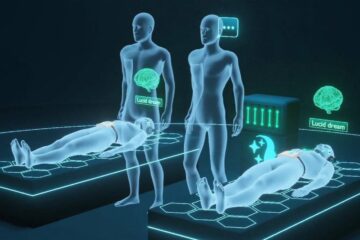
A new study from the IMT School for Advanced Studies Lucca finds that vivid, immersive dreams can actually make sleep feel deeper, even when brain activity is higher.
Researchers at Washington State University and the University of Calgary recently published a study in Proceedings of the National Academy of Sciences showing that cannabis use led to a measurable increase in food intake among human participants, regardless of body weight, sex, or when they last ate.
For many years, researchers have questioned whether the psychedelic compound N,N-dimethyltryptamine (DMT) is produced naturally in the brain and if it might act as a signaling substance similar to serotonin.
In a recent study published in Neuropsychopharmacology, researchers from the University of Technology Sydney (UTS) found that inflammation in a key decision-making region of the brain led to more deliberate behavior, rather than more compulsive actions.
Recent research from the University of Liège is offering new insight into that question, suggesting a deeper relationship between language and awareness than previously understood.
This week, quantum mechanics holds at the macroscopic scale, and scientists develop a novel method using shockwaves from sonic booms to track objects entering Earth's atmosphere.
This week in stories we're covering at The Debrief, scientists have identified a "master regulator" in the brain, and an ancient Roman factory is unearthed.
Although researchers can monitor brain activity associated with perception, pain, and awareness, it remains unclear which neural pathways are tied to the origins of consciousness.
Laboratory tests of a novel serotonin-binding compound have revealed an unexpected disconnect between receptor activation and behavior, raising new questions about how psychedelic effects emerge in the brain.
Researchers found that prompting people to question their own doubts, a process called meta-cognitive doubt, can actually strengthen commitment to goals that are central to their identity.
New research reveals how psilocybin reshapes connections across the brain, helping explain how it can ease depression symptoms for weeks or even months.
Apple is reportedly working with brain-computer interface (BCI) company Synchron to develop technology that allows users to control their iPhones and other Apple devices using their minds.
Neuralink, Elon Musk’s brain-computer interface (BCI) company, has received the FDA's “breakthrough device” designation for its innovative 'Blindsight' implant.
Synchron, a competitor to Neuralink, has announced one of its patients with ALS is now able to control devices using only his mind with its brain chip implant.
In a recent study, researchers at Aalto University used Functional Magnetic Resonance Imaging (fMRI) to explore how different types of love activate the brain.
Neuralink has implanted its experimental N1 brain-computer interface (BCI) within a second patient, with Elon Musk, the company's CEO, saying the procedure is “working very well.”
An investigation into how humans process speech is revealing new deep insights into what happens in our brains when we use language in our daily communication with others.
Half a billion years ago, an ancient wormlike animal was preserved in a seabed, whose fossil remains are now challenging our current theories about brain evolution.